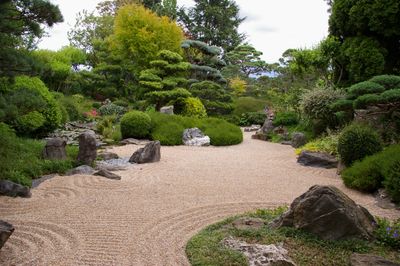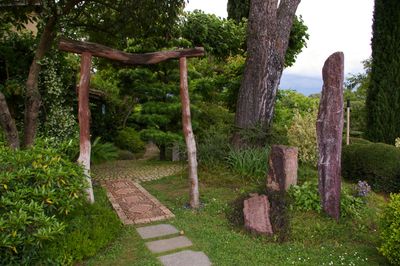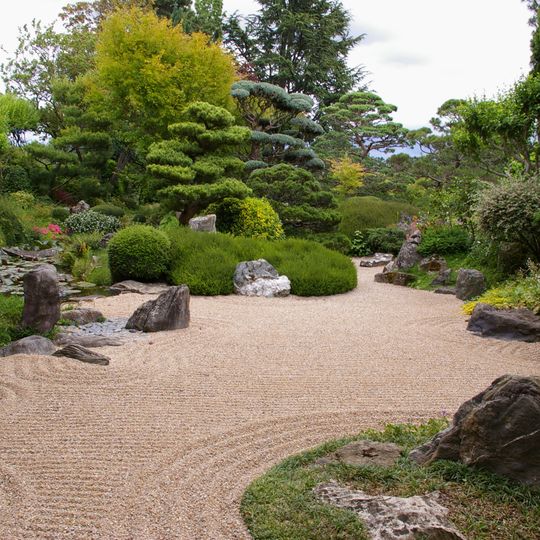
Jardin zen d'Erik Borja, Japanese garden in Beaumont-Monteux, France.
Erik Borja's Zen garden is a 3-hectare property near the Herbasse river featuring distinct zones such as meditation spaces, tea gardens, waterfalls, and Mediterranean sections. The landscape employs elevation changes and natural water features to define different areas.
Erik Borja began creating this garden in 1973 following his art studies in Paris, with later visits to Japanese gardens in Nara and Kyoto providing direct inspiration. These formative experiences shaped the garden's final design and approach.
The garden's name honours Erik Borja, a visual artist and sculptor who created it in 1973 with his partner Frédéric Ditis around a restored old sheepfold. Its six parts follow Japanese models: the welcome garden to the west applies Chinese feng shui and holds a tsukubai for the visitor's purification, the tea garden leads to a tea pavilion where the host serves tea, and the Dragon garden takes its cue from the Herbasse, the river that has twice burst its banks and destroyed it.
The garden lies at Beaumont-Monteux in the Drôme, with the Herbasse flowing along one side; the Dragon garden takes its name from that river, which has twice burst its banks and damaged the garden. The meditation garden is raked each morning, so the lines in the gravel are freshest early in the day. The welcome garden, on the west side, holds a tsukubai for purifying visitors before entering.
The Dragon Garden takes its name from the Herbasse, the river that runs alongside the property and has twice burst its banks, destroying the garden. Erik Borja also reused stones found around the old sheepfold for the south-facing Mediterranean garden, echoing how Algerian peasants recycled ancient stones.
The community of curious travelers
AroundUs brings together thousands of curated places, local tips, and hidden gems, enriched daily by 93,540 contributors worldwide.