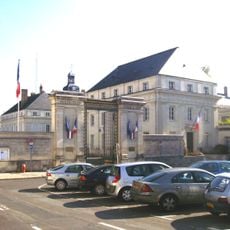
Gallo-Roman Temple of Tours, Roman temple ruins in central Tours, France.
The Gallo-Roman Temple of Tours is a fanum-type sanctuary of the late 1st century CE, now known only from underground remains beneath the Nouvel Olympia theatre and the Regional Dramatic Arts Centre in central Tours. Its circular cella measured 34.80 m in external diameter and stood at least 20 m high, preceded to the east by a classical Roman pronaos with a triangular pediment, all within a peribolus of about 0.7 hectares.
The sanctuary was built in the late 1st century CE in the Roman city of Caesarodunum, replacing an earlier temple constructed during the first half of that century. Excavations during the 1990s revealed wooden foundations and architectural fragments that had survived underground.
The building reflects how Roman and Celtic religious beliefs coexisted in this region, visible in its round design that differs from typical Roman temples. This shape shows how local traditions shaped religious architecture even under Roman rule.
The remains are located beneath modern buildings in the old town of Tours and are not visible as open ruins. Visitors can learn about the archaeological discoveries through local museums or informative plaques at street level.
The temple's cella had an external diameter of 34.80 metres, nearly twice that of the Tour de Vésone in Périgueux at 19.60 metres. A 3D reconstruction on the INRAP website shows the circular Celtic cella joined to a columned Roman pronaos with a triangular pediment. Pierre Audin called it a fortunate alliance between Romanization and loyalty to indigenous traditions.
The community of curious travelers
AroundUs brings together thousands of curated places, local tips, and hidden gems, enriched daily by 93,776 contributors worldwide.