Église Saint-Cyr et Sainte-Julitte d'Anet, church located in Eure-et-Loir, in France
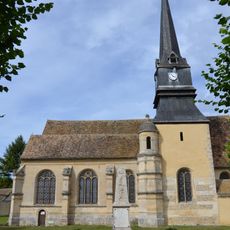
The église Saint-Cyr et Sainte-Julitte d'Anet is a light brown and tan stone church. Its tower rises to a steep four-sided dark roof, with a louvered opening, a clock, a small arched window and a larger pointed-arch window below; a crocketed pinnacle projects from its left side. The gabled section to the left has a rose window, three arched windows and a stone balustrade. The building is 41 m long, 20.45 m wide and 53 m high.
Construction began in the 12th century and continued with additions through the 13th, 15th, and 16th centuries, with the main structure completed around 1580. The building survived difficult periods and was designated a protected monument in 1960.
The dedication to Saints Cyr and Julitta refers to a mother and her young son martyred at Tarsus, a pair venerated in early Christianity. The parish now belongs to the Blessed John Paul II parish in Pays Anetais, within the Drouais deanery. In the baptismal chapel, a painting of Saint Remigius by Paul Balze, made in Rome in 1838, is listed as a historical monument.
The church stands in Anet, in the Eure-et-Loir department, within the parish of Bienheureux Jean-Paul II en Pays Anetais, attached to the Drouais deanery. Visitors enter through the west facade; the tower and its clock face the street. The building is 41 m long, 20.45 m wide and 53 m high, so allow time to walk around the exterior before going in.
Two paintings inside are themselves protected as historical monuments: a portrayal of the Baptism of Christ from the 18th century and a portrait of Saint Remigius painted by Paul Balze after his time in Rome. These works show how artistic treasures have been preserved in this church across centuries.
The community of curious travelers
AroundUs brings together thousands of curated places, local tips, and hidden gems, enriched daily by 93,337 contributors worldwide.