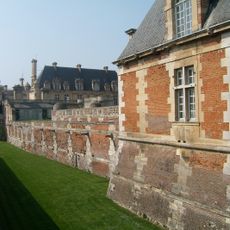
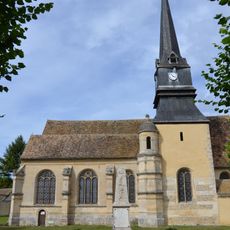
Abbaye Notre-Dame d'Ivry-la-Bataille, Benedictine abbey in Ivry-la-Bataille, France
The Abbaye Notre-Dame d'Ivry-la-Bataille is a former Benedictine abbey of which only the entrance portal and a Romanesque arcade remain, both classified as historical monuments in 1932. The portal preserves one of six column statues that once adorned its jambs, and the adjacent arcade is a round-headed arch. The site lies north of the town, outside the old enclosure.
Founded around 1071 by Roger of Ivry, cupbearer to William the Conqueror, the abbey stood north of the walled town. It was burned in 1087, then sacked by Calvinists in 1563 during the first War of Religion, when the abbey church was lost under abbot Philibert Delorme. Rebuilt from 1668 under commendatory abbot Philippe de Vendôme, it was suppressed and sold as national property in 1791.
The abbey's arms are those of the lords of Ivry: gold with three red chevrons. In 1687 the Monasticon Gallicanum devoted plate XXII to a view of the abbey, and the collector Gustave de Reiset (1821-1905) gave the town hall an engraving of the estate's original plan. The two abbey bells were sent to Breuilpont and exchanged for those of Saint-Martin.
The ruins are located on Rue de l'Abbaye near the Eure River in Normandy's Eure department. The site is accessible for walking through the remains, which are spread out enough to appreciate the former layout of the monastic grounds.
The fire that struck the abbey came in 1087, not 1092. After the Calvinists pillaged it in 1563 during the first War of Religion, the abbey church was lost; it was raised again under abbot Jacques de Poitiers. From 1668 the Maurist congregation rebuilt the monastery under commendatory abbot Philippe de Vendôme.
The community of curious travelers
AroundUs brings together thousands of curated places, local tips, and hidden gems, enriched daily by 93,133 contributors worldwide.