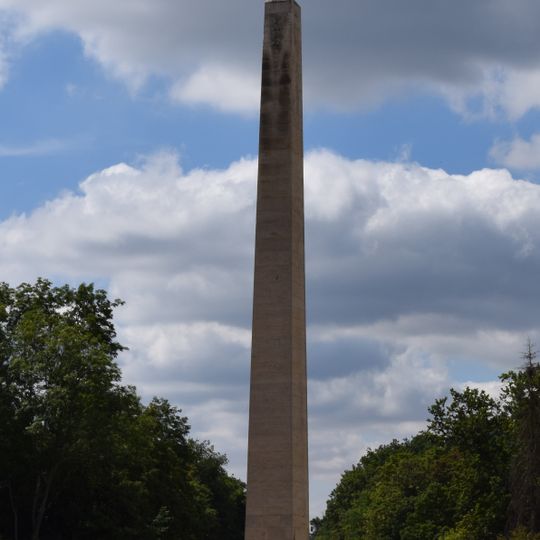
Marie-Antoinette obelisk, Historic obelisk in Fontainebleau, France
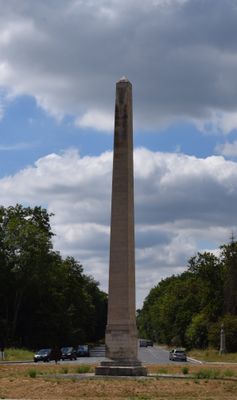
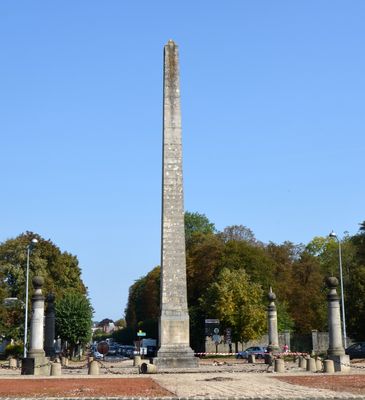
The Marie-Antoinette obelisk is a 21-metre stone obelisk at the Carrefour de l'Obélisque in Fontainebleau, where the roads to Nemours, Moret, Bourron and Ury meet. It is a scaled-down copy of the Vatican obelisk in St Peter's Square, with a four-sided tapering shaft on a rectangular pedestal. The light grey stone shows dark weathering streaks and a faint greenish stain near the top.
The obelisk was built in 1785 under architect Pierre Rousseau and financed using money that was originally meant for renovations at the Château de Fontainebleau. This shift in funding shows how royal projects could be redirected during this time.
Each of the four faces bears a bronze inscription: one honours Marie-Antoinette as Queen of France and Navarre, the other three give the birth dates of her children Louis-Joseph, Louis-Charles and Marie-Thérèse. The last one is wrong, giving 28 December 1778 instead of 19 December 1778, probably copied from a reference book of the time. The bronzes were torn off in 1789 and only re-established in 1864.
The monument sits at Carrefour de l'Obélisque, roughly 850 meters from the Château de Fontainebleau, and stays open year-round. Its location at a road crossing makes it easy to find and you can view it from all angles.
In 1792, revolutionaries placed a tin Phrygian cap on top as a symbol of freedom, which was later replaced by Napoleon's imperial eagle in 1805. These two symbols marked different political eras in France's history.
The community of curious travelers
AroundUs brings together thousands of curated places, local tips, and hidden gems, enriched daily by 94,210 contributors worldwide.