Table du Roi, Historic monument in Fontainebleau Forest, France.
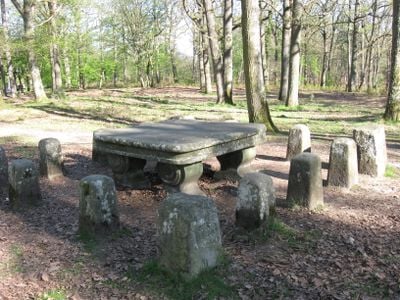
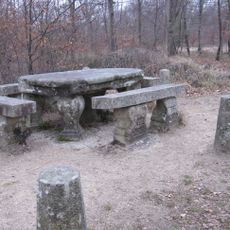
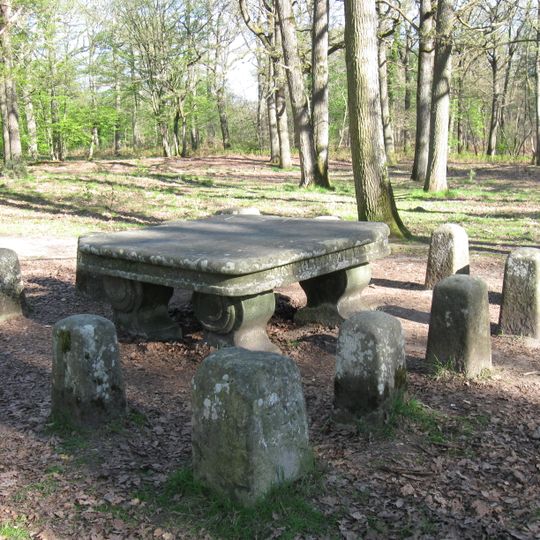
Table du Roi is a stone table in the Fontainebleau Forest, north of the town of Fontainebleau. Its thick, flat top rests on four curved, scroll-like supports, and the weathered grey stone carries patches of lichen. Upright, irregular stone blocks stand around it, one at each short end and one to the side, among fallen leaves and tree trunks. The date 1723 is carved in relief on one of its pillars.
The forest of Bière, later Fontainebleau, passed into royal hands in 1068; from at least then, forest users had to gather each 1 May at the Table du Roi, pay dues and pay homage to the king before the master of waters and forests, a practice ended by the Revolution. The present table was set up in 1723, damaged during the Revolution and restored in 1854. On 13 October 1870 a company of the 2nd Légion des volontaires de la Nièvre fought a column of Württemberg dragoons there, forcing them back on Melun.
Each 1 May, forest users had to gather here before the master of waters and forests, pay homage to the king and hand over dues, on pain of a fine. The abbess of Lys brought a ham and two bottles, a Melun baker a large cake, and newlyweds five deniers and a cake each; the officers then feasted at the table. The Revolution ended the custom.
The table sits freely accessible in the forest and can be reached on foot. Visitors should know it is a simple spot with no facilities or services.
The table served as the starting point for many French cyclo-cross championships in the first half of the 20th century, with the finish at the Table du Grand Maître. On 13 October 1870, a company of the 2nd Legion of Nièvre volunteers fought a column of Württemberg dragoons here, forcing them to flee toward Melun.
The community of curious travelers
AroundUs brings together thousands of curated places, local tips, and hidden gems, enriched daily by 93,466 contributors worldwide.