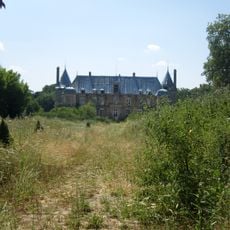
Château de la Houssaye-en-Brie, Medieval castle in La Houssaye-en-Brie, France.
Château de la Houssaye-en-Brie stands beside a body of water in Seine-et-Marne. Its right side is dominated by a massive cylindrical tower of pale rough-hewn stone, topped by a shallow conical roof of reddish-brown tiles edged in dark green and pierced by one tall mullioned window. Attached on the left is a red-brick block with pale stone quoins and window surrounds, a steep grey roof with chimneys and dormers, and a round turret with a grey conical roof at its far end.
The castle was built in the late 13th century and underwent extensive renovations after General Augereau acquired it in 1801. Allied bombing during World War II damaged a tower and the left wing, marking a significant turning point in the building's condition.
In August 1937 the castle became a temporary shelter for Spanish Republican exiles, intellectuals and artists; after the Spanish Civil War it housed writers Anna Murià i Romaní and Mercè Rodoreda and poet Agustí Bartra. After the Second World War, Arletty stayed 18 months under house arrest there, and Sacha Guitry was also received.
The castle stands in the commune of La Houssaye-en-Brie, in Seine-et-Marne, beside a body of water. It has been listed as a monument historique since 28 December 1999. The grounds include a park where Joséphine Grach, first wife of General Augereau, is buried.
In August 1937, before World War II, the castle briefly became a shelter for Spanish Republican exiles, intellectuals and artists. Among those received were the writers Anna Murià i Romaní and Mercè Rodoreda and the poet Agustí Bartra. The German garrison came later, in 1940.
The community of curious travelers
AroundUs brings together thousands of curated places, local tips, and hidden gems, enriched daily by 92,890 contributors worldwide.