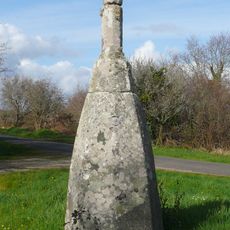
Menhir de Kergleuhan, Prehistoric monolith in Trégunc, France
The Kergleuhan menhir, also called the Kerangallou or Kerdunus menhir, is a granite block 5.50 m tall standing upright in Trégunc, Finistère. It is widest near the base and tapers to a rounded top, leaning slightly to the right; its left face is pale grey and fairly smooth, while the right side and upper part carry dark, textured growth. Dense vegetation hides the lower section, and no inscription is visible on the stone.
This stone monument was erected by prehistoric populations in western France thousands of years ago. It is part of a broader group of similar structures built across the region during ancient times.
The stone stands in a region known for its prehistoric monuments and shows how important such places were to the earliest inhabitants. Visitors can today explore the surroundings and understand the role these stones played in the ancient world.
The menhir stands in vegetation on the edge of Trégunc, about 400 m south-east of the Kérangallou menhir; the two can be combined in one walk. The lower part of the stone is hidden by dense growth, so approach from the cleared side. No marked path or sign is recorded; expect uneven ground.
The stone was granted national heritage protection status in 1965, officially recognizing its archaeological importance. This designation helped preserve the site for future generations and made it a key location for studying ancient cultures in Brittany.
The community of curious travelers
AroundUs brings together thousands of curated places, local tips, and hidden gems, enriched daily by 94,228 contributors worldwide.