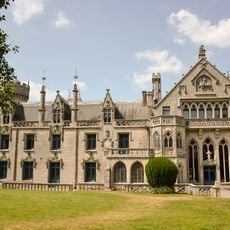
Fort du Cabellou, Military fort in Concarneau, France.
Fort du Cabellou is a low stone fortification with walls of rough grey and tan stones forming squared corners. A short wall section on the left has two small rectangular openings, while a longer, taller wall to its right features a horizontal row of five small square openings. Further right, a stone structure with a sloping, stepped roof covered in patches of vegetation has two red-brown doors at ground level. The walls sit directly on flat, mown green grass, with a small pile of stones in front of the right-hand building.
The fort was built in 1746 to protect the coast during military tensions with England and to secure the strategic waterways in this region. It was part of a broader defensive strategy that included multiple fortifications along the Breton coast.
The fort's name comes from the Cabellou peninsula where it stands. In spring and summer, biniou and bombarde players sometimes use the site to rehearse, and Breton tunes such as gavottes de l'Aven, jabadao and gymnasqua carry on the wind. The powder magazine's stepped stone roof was built to resist cannonballs.
The fort stands on flat, mown grass on the Cabellou peninsula, with the sea-facing parapet and its six embrasures looking toward the Bay of La Forêt. The entrance is flanked by two half-bastions, and a German blockhouse from World War II is attached to the fort. The site is owned by the municipality of Concarneau.
The fort was decommissioned in the 19th century as artillery improved, then during World War II the Germans built two bunkers on the Cabellou peninsula, one of them attached directly to the fort. The commune of Concarneau has owned the site since 1960, and it was classified as a monument historique on 8 November 1962.
The community of curious travelers
AroundUs brings together thousands of curated places, local tips, and hidden gems, enriched daily by 94,071 contributors worldwide.