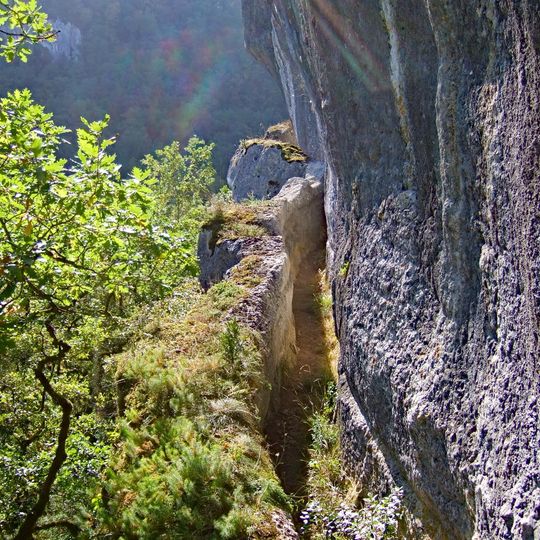
Aqueduc de Vers, Roman aqueduct in Saint Géry-Vers, France
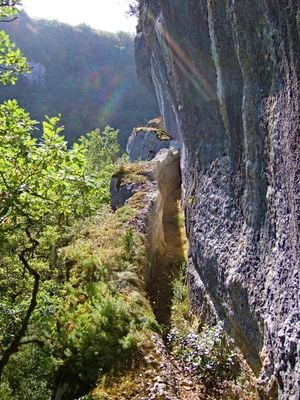
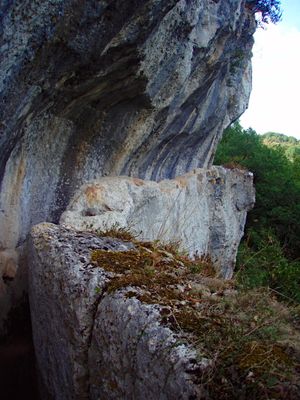
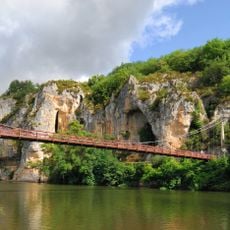
The Vers Aqueduct is a 33 km Roman water channel running from a spring below the Murcens oppidum to the baths of Divona Cadurcorum (Cahors), dropping 38 m over its course. In the photograph, a massive grey rock face with deep vertical fissures rises on the right, while a narrow dry channel runs down the centre beside a lower earthen slope; a strip of flat stonework lies near the bottom of the gap.
The aqueduct carried water from a spring below the Murcens oppidum, near the Fontaine de Polémie, to the Roman baths of Divona Cadurcorum, now Cahors. Charcoal analyses by Didier Rigal's team point to a construction between 10 BC and AD 10; it probably ran until the late 4th or early 5th century. A 17th-century brick naming Pontius Polemius led to a false attribution, rejected because known Polemius figures are too late. The remains in Vers were inscribed as monuments historiques on 26 November 1953.
The section of the aqueduct in Vers was listed as a monument historique on 26 November 1953. The name Divona comes from the spring goddess of the Gallic oppidum of Murcens, whose spring fed the conduit. The aqueduct's route crosses 784 private properties, so most of it is seen from public paths.
The aqueduct can be reached from local walking paths and via the D49 road that runs past the site. The ground is easily accessible, and visitors can view the structure from various points.
The aqueduct crosses 784 private properties along its 33 km course, so most of its surviving channel and walls lie on farmland rather than public land. The section in Vers commune was listed as a monument historique on 26 November 1953.
The community of curious travelers
AroundUs brings together thousands of curated places, local tips, and hidden gems, enriched daily by 94,761 contributors worldwide.