Palais de justice de Chambéry, Neoclassical courthouse in Chambéry, France
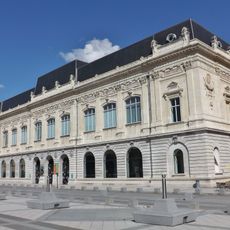
The Palais de justice de Chambéry is a neoclassical courthouse of Sardinian design. Its facades have a stone ground-floor base and thirteen bays painted Sardinian red, a colour applied in 1976 over the original yellow coating. The central section projects beneath a plain triangular pediment, with solid wood entrance doors and seven bays separated by engaged Ionic columns; a stone balustrade runs between the base and these bays.
Construction of the courthouse began in 1850 under Victor Emmanuel II and was completed in 1860 when Savoy became part of France. This period marked a turning point in the region's political status and institutional role.
The courthouse's ceremonial hall is where the results of the 29 April 1860 plebiscite on Savoy's annexation to France were proclaimed. The building has no official inauguration: the formal installation of the first French attorney general on 28 June 1860 served that role. The facades were originally covered in yellow render; the Sardinian red dates from restoration work in 1976.
The courthouse stands at the edge of the Jardin du Verney, chosen in 1850 because it was the only plot large enough and close to the prisons, whose inmates were walked through the centre. The main entrance sits in the projecting central section, reached by the stone balustrade between the base and the seven Ionic-columned bays.
The cornerstone laid on 27 May 1850 by Victor Emmanuel II sealed a rosewood box holding ten gold and silver coins and medals bearing the effigies of Charles Albert and Victor Emmanuel II. The box remains in the foundations, invisible to visitors.
The community of curious travelers
AroundUs brings together thousands of curated places, local tips, and hidden gems, enriched daily by 93,944 contributors worldwide.