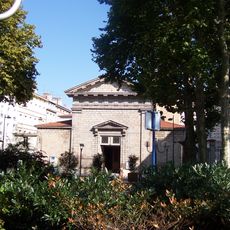
Demeure Chamoncel, Renaissance house in Saint-Étienne, France.
Demeure Chamoncel is a house in Saint-Étienne made of two parts: a 15th-century facade with timber framing, and a 16th-century addition in coal-bearing sandstone and ashlar. A second building stands at the rear, separated by a courtyard and linked by galleries on the upper floors. A spiral staircase serves the whole complex, and some ceilings have local fern-pattern coffering.
A timber beam on the first floor is dated to 1547, coinciding with the death of King Francis I and reflecting the monarchy's influence over the region at that time. The residence was built during an era when Saint-Étienne experienced growing prosperity through mining and craftwork under royal authority.
The house takes its name from Claude Chamoncel, a later owner, while its other name, maison François Ier, comes from the year 1547 carved on a first-floor beam, the year King Francis I died. From the Revolution onward, shopkeepers and craftsmen ran their businesses on the ground floor, and rooms upstairs housed many immigrants.
The residence sits in Saint-Étienne's old district and is easy to reach on foot, with clear sightlines from the surrounding streets. Access is typically available during special heritage events, so visitors should check ahead to confirm when viewing is possible.
The building is constructed from coal-bearing sandstone quarried locally, a material choice that ties the structure directly to Saint-Étienne's heritage as a mining region. This stone reflects how 16th-century builders integrated local resources into their architectural designs.
The community of curious travelers
AroundUs brings together thousands of curated places, local tips, and hidden gems, enriched daily by 93,785 contributors worldwide.