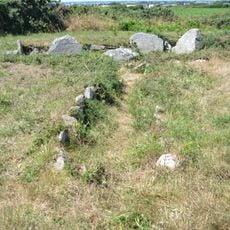
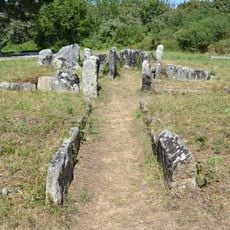
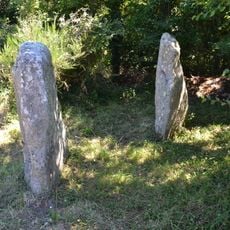
Dolmen d'Ar Roc'h, Neolithic dolmen in Ploemeur, France.
Dolmen d'Ar Roc'h is a megalith in Ploemeur, Morbihan, whose capstone weighs an estimated 7 tonnes and rests on four upright stones enclosing a square burial chamber of 2.20 m by 2.20 m. The south-west orthostat, left of the entrance, is a thin slab 2.50 m long and 0.16 m thick, bearing twenty-five cupules of various sizes on its inner face. The surrounding cairn is still visible and measures 8 m in diameter.
In 1868 the English archaeologist W. C. Lukis drew a plan of the monument. In 1918 Zacharie Le Rouzic found fragments of a red clay bell-beaker decorated with dotted lines in the remains of the tumulus, dated to the end of the Neolithic or the beginning of the Copper Age.
The 25 cupules on the inner face of the south-west orthostat are the monument's most noted feature; the slab itself is 2.50 m long and only 0.16 m thick. The archaeologist W. C. Lukis drew a plan of the dolmen in 1868. Fragments of a red caliciform vase decorated with dotted lines, found in the tumulus remains by Zacharie Le Rouzic in 1918, were dated to the end of the Neolithic or the beginning of the Copper Age.
The dolmen stands in open ground at Ploemeur, in Morbihan. The cairn still visible around the chamber measures 8 m in diameter, so the stones sit close to the path rather than deep in fields. The ground is uneven and can be muddy; sturdy footwear helps.
The cairn still visible around the chamber measures 8 m in diameter, so the covering mound survives only as a low ring rather than an intact tumulus. In 1918 Zacharie Le Rouzic found fragments of a red caliciform vase decorated with dotted lines in its remains, dated to the end of the Neolithic or the beginning of the Copper Age.
The community of curious travelers
AroundUs brings together thousands of curated places, local tips, and hidden gems, enriched daily by 93,861 contributors worldwide.