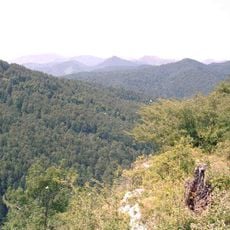
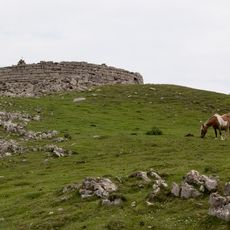
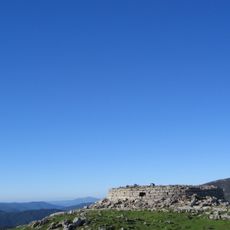
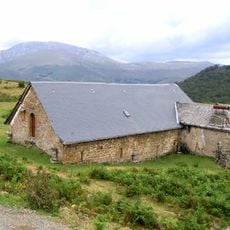
Harpea's Cave, Natural cave in Estérençuby, France.
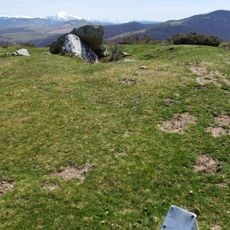
Harpea's Cave is a rock shelter in Estérençuby, a few metres from the Franco-Spanish border. Its mouth is a dark, roughly triangular opening at the base of a curved rock face, with a stone slab at the bottom. Grey layered bands arc over the entrance, and the rock forms a thick overhang above it, set in a grass-covered slope with exposed strata.
The limestone deposits formed during the Cretaceous period roughly 100 million years ago, when the area lay beneath a shallow sea. These ancient marine sediments were later uplifted by mountain-building forces and carved by water into the cavern we see today.
The name Harpea comes from Basque: harri (stone, rock) and pean (underneath), so it means 'the place under the rock'. The cave lies in Estérençuby, a few metres from the Franco-Spanish border, in the Basque-speaking area of Lower Navarre.
Harpea's Cave is a rock shelter rather than a deep gallery, so no long underground route is involved. It lies a few metres from the Franco-Spanish border, reached on foot from Estérençuby; the grassy slope in front of the opening is uneven, so sturdy footwear helps.
The cave displays an anticline structure where the oldest rock layers are positioned in the middle instead of at the edges. This unusual arrangement reveals how powerful the folding and lifting forces were that shaped the Pyrenees mountains.
The community of curious travelers
AroundUs brings together thousands of curated places, local tips, and hidden gems, enriched daily by 94,014 contributors worldwide.