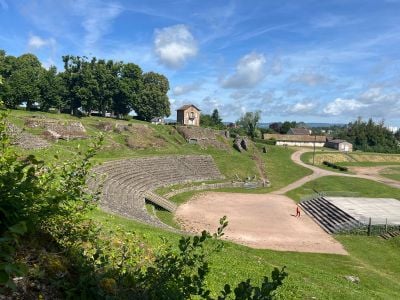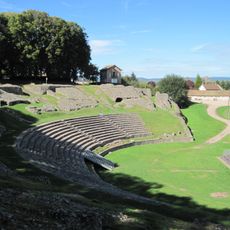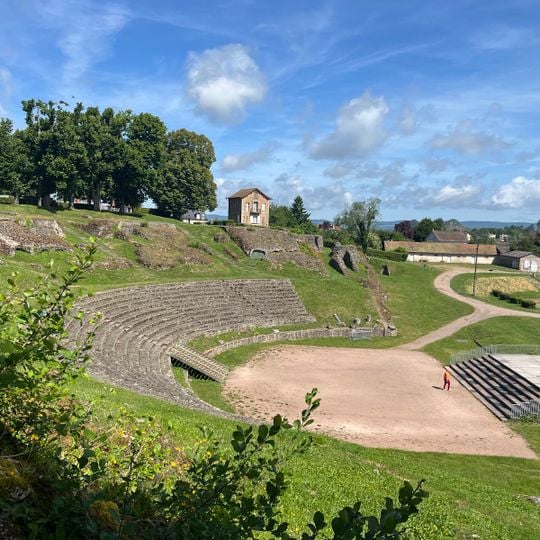
Autun amphitheatre, Roman amphitheatre in Autun, France.
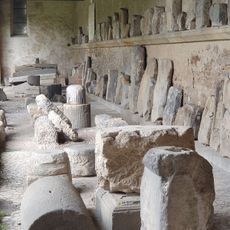
The Autun amphitheatre was a Roman structure, now completely destroyed, known from a 16th-century engraving and 19th-century excavations. It measured about 150–158 m by 130 m with an arena of 74 m by 49 m, and had two arcaded storeys with pilasters, an attic, and walls 2.30 m thick. A vault fragment is kept in the Musée Rolin.
The structure rose during the first century AD when Autun flourished as a Roman colonial settlement known as Augustodunum. It stood as evidence of Rome's power and prosperity reaching far into provincial territories.
Tacitus records in his Annals that a gladiator school existed at Augustodunum in 21, under Tiberius, though archaeology has not confirmed it; this hints at an earlier, perhaps wooden, amphitheatre. The known arena, built under the Flavians between 69 and 96, held crowds for shows in a city whose theatre next door was the largest in Roman Gaul.
Nothing of the amphitheatre stands today; its outline survives only as a dip in the ground on the north-east edge of the avenue du 2e Dragons, near the service station, about fifty metres from the end of the Roman theatre. Look for the depression beside the road leading to Chalon-sur-Saône.
The amphitheatre survives only as a depression in the ground beside the avenue du 2e Dragons, near a petrol station, about fifty metres from the end of the Roman theatre. Its outline is known from a 16th-century engraving and from excavations in 1832 and 1844 by the Société éduenne, whose surveyor Jean Roidot-Déléage drew up a plan rediscovered in the mid-20th century.
The community of curious travelers
AroundUs brings together thousands of curated places, local tips, and hidden gems, enriched daily by 92,800 contributors worldwide.