Cimetière Pasteur de Bagnolet, Municipal cemetery in Bagnolet, France
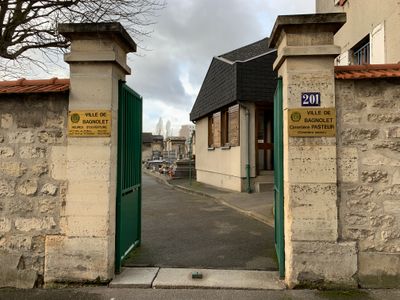
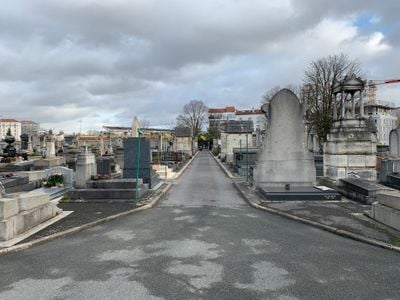
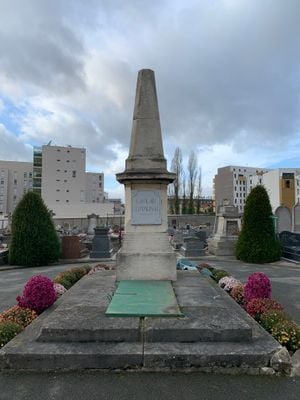
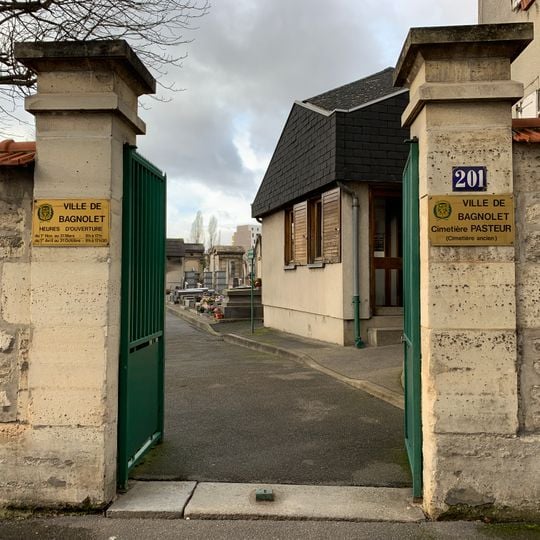
The Cimetière Pasteur de Bagnolet, also called the old cemetery, is one of the two cemeteries of Bagnolet, alongside the Cimetière Raspail. It is entered from Avenue Pasteur or Rue Sadi-Carnot through green metal gates set between pale stone pillars; a yellow plaque on the right pillar reads "Cimetière PASTEUR (Cimetière ancien)". A paved central roadway lined with low stone curbs leads past graves, including the 1894 monument to G. Augereau.
The cemetery is the oldest in Bagnolet and served the working-class population of the area in its early years. In 1833, it was officially closed to new burials by order of the sub-prefect of Saint-Denis, though it was later expanded in 1890 when a neighboring piece of land was acquired.
The cemetery's name comes from Avenue Pasteur, one of its two access streets; the other is Rue Sadi-Carnot, and a service gate opens north on Rue de Noisy-le-Sec. Its graves are modest and rarely ornamented, since the first people buried here belonged mainly to the town's poor working class. Among them are the first socialist mayor Raoul Berton and the actress Odette Laure.
The cemetery is accessible by metro on line 11, with Mairie des Lilas being the closest station, and also by bus. The main entrance is on Rue Sadi Carnot, while a service entrance can be found on the north side on Rue de Noisy-le-Sec.
Among those buried here is Amélie Élie, known as Casque d'Or, a Belle Époque figure whose story inspired a French film of the same name. The site also holds the graves of Odette Laure, a César-winning actress, and Rosy Varte, who received a 7 d'Or for her television work.
The community of curious travelers
AroundUs brings together thousands of curated places, local tips, and hidden gems, enriched daily by 94,370 contributors worldwide.