Château de l'abbaye de Cysoing, French heritage castle in Cysoing, France.
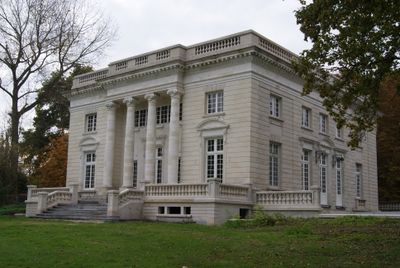
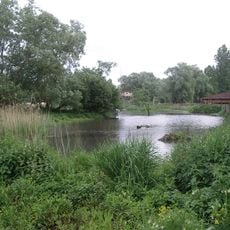
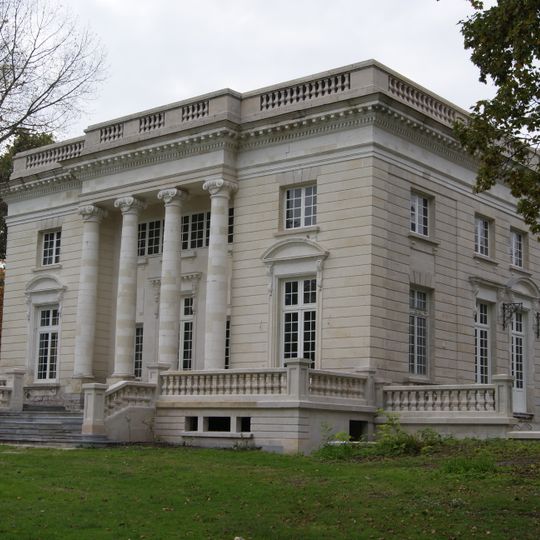
Château de l'abbaye de Cysoing is a light-coloured ashlar building erected around 1800 for the Lille lawyer Philippe-Joseph Riquet as an exterior copy of the Petit Trianon at Versailles. Its main facade has a slightly projecting central bay of four colossal Ionic columns, flanked by a bay on each side under a curved pediment, with a balustrade along the roofline and terrace. It stands on a lawn in a park of about 2.5 hectares beside two large fishponds.
The castle was built around 1800 following the destruction of the abbey during the French Revolution in 1793 and reused many building materials from the former religious site. Its construction marks the shift from spiritual to secular use of the location in the modern era.
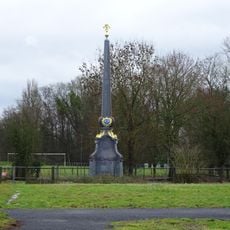
The name recalls the abbey Saint-Calixte founded by Saint Evrard in the 9th century and destroyed at the Revolution; the château was built on its grounds. In the park stands the Pyramide de Fontenoy, an obelisk raised in honour of Louis XV to mark his stay at the abbey in 1744. The romantic winding paths laid out from 1824 were known as "Le labyrinthe" until the mid-20th century.
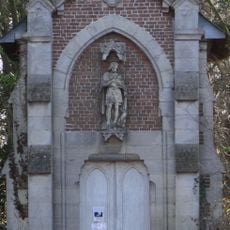
The castle stands in a park of about 2.5 hectares, entered through an 18th-century gate; inside, two large fishponds, a tunnel built with stone from the abbey and an island holding a former chapel lie close to the building. The ground floor opens on the west side facing the ponds, while the basement is reached from the north side.
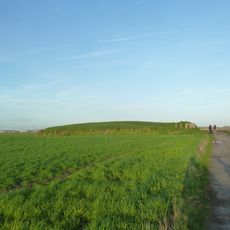
The château was built partly against the abbey wall, and its lower level opens directly onto the north side while the ground floor faces west toward the two former fishponds. Riquet also used abbey stone to dig a tunnel beneath an artificial earthwork near the building.
The community of curious travelers
AroundUs brings together thousands of curated places, local tips, and hidden gems, enriched daily by 93,325 contributors worldwide.