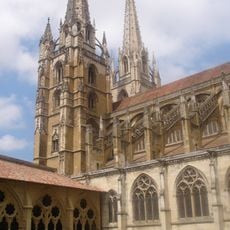
Cloister of the Cathédrale Notre-Dame de Bayonne, Gothic cloister in Bayonne, France
The cloister of Bayonne cathedral forms a quadrilateral of four covered galleries around a central garden courtyard, with pointed Gothic arches resting on paired colonnettes. Its arcades open onto the cathedral's south flank, and the walkways are roofed with timber and stone vaulting. Carved keystones and capitals mark the bays along each gallery.
Begun in the 13th century and completed in the 15th, the cloister grew with the cathedral's successive building campaigns. Its 19th-century restoration, directed by Paul Abadie and then Émile Boeswillwald, rebuilt much of the decayed stonework. With sides of about 50 metres, it ranks among the largest cathedral cloisters in France.
The cloister adjoins the cathedral's south side, where the pilgrim route through Bayonne passed on the way to Santiago de Compostela. Look for the carved scallop shells and pilgrim figures among the vault bosses and corbels, marks of that traffic. The space is still used for processions and quiet prayer.
The cloister is entered from the cathedral's south side, not through the main west door; the passage opens off the nave near the transept. Parts of the galleries are closed during services, and the courtyard garden is not always open, so confirm access at the cathedral before planning a visit.
Look for the keystone of the north gallery, carved with a small figure holding a staff, and the 19th-century restoration masonry that differs in tone from the medieval stone. The cloister also holds the tomb slab of a Bayonne canon, set upright against the wall rather than in the floor.
The community of curious travelers
AroundUs brings together thousands of curated places, local tips, and hidden gems, enriched daily by 93,326 contributors worldwide.