Botanic school of Jardin des Plantes, Botanical education center in Jardin des Plantes, France.
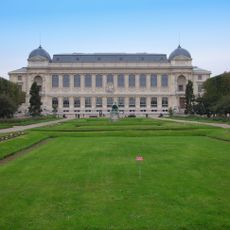
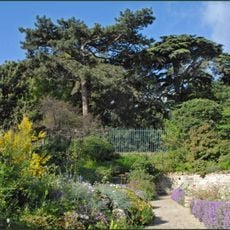
The École de botanique occupies the centre of the Jardin des Plantes, bounded by the allée Cuvier to the north and the allée Lacroix to the south, with its west entrance facing the large greenhouse. Its beds follow the APG III classification of 2009, showing one example species per family and genus, and four squares illustrate adaptation, diversification, evolutionary convergence and the direction of evolution. A Laricio pine grown from Corsican seeds brought back by Étienne-François Turgot was planted here in 1774 and, after being struck by lightning in the 19th century, stands with its top cut off.
Botany was taught near this site from the 16th century by Nicolas Houël, but the school itself dates from 1635, nine years after the Jardin royal des plantes médicinales was created in 1626. Antoine-Laurent de Jussieu and André Thouin fixed its present boundaries in the last quarter of the 18th century, and Thouin with René Desfontaines laid out its topography in the early 19th century. The planting plan was reworked in 1683, 1773-1774, 1824, 1843 and 1954-1957; from 1957 to 2008 it followed Adolf Engler's 1924 classification, and since 2017 the APG III system of 2009.
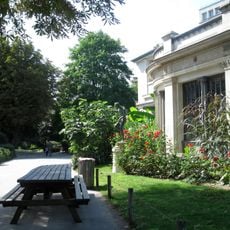
The name reflects its role as a teaching space dedicated to plant science and systematic study. Visitors can observe how specimens are organized for study and see how students and researchers actively use the grounds for hands-on learning.
The west entrance faces the large greenhouse, and the east entrance faces the ecological garden; the school is bordered by allée Cuvier to the north and allée Lacroix to the south. An underground passage on the north-west side leads to the neighbouring alpine garden, which is closed in December, January and February. The beds are laid out around a central orientation table.
At the centre stands a Pinus nigra grown from seeds Étienne-François Turgot brought back from Corsica, planted in 1774 among the conifers. Struck by lightning in the 19th century, it was truncated and still stands, shorter than its neighbours.
The community of curious travelers
AroundUs brings together thousands of curated places, local tips, and hidden gems, enriched daily by 94,408 contributors worldwide.