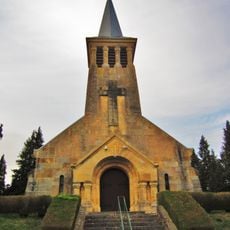
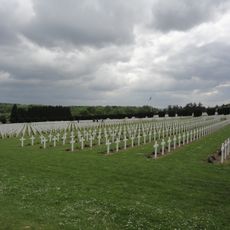
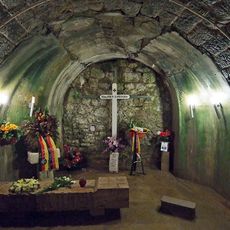
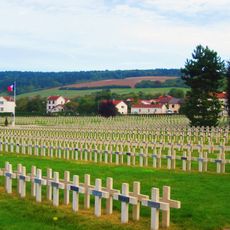
Fort Moulainville, Military fortification in Moulainville, France.
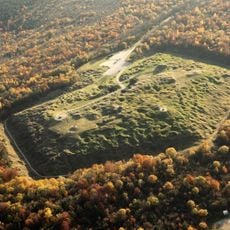
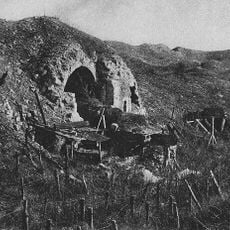
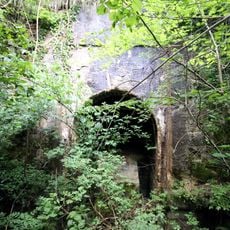
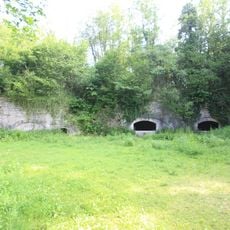
Fort Moulainville is a stone fort on a wooded ridge at 362 metres between Moulainville and Eix, built as an irregular hexagon covering 2.8 hectares and enclosed by a dry ditch. Its masonry walls of cut stone blocks carry an earth-covered roof, and the entrance front shows a rounded arch with a smaller rectangular opening beneath it, flanked by two arched recesses. The barracks adjoin the gorge ditch, while the artillery stood on platforms separated by five hollow traverses.
Built from 1885 to 1886 alongside Fort Douaumont, the fort strengthened the second ring of detached forts on the right bank of the Meuse. In 1887 it briefly bore the name Fort Feuquières, after a former governor of Verdun, before the decree was revoked that October. From 1889 to 1891 its barracks received a 2.50 m concrete shell, and between 1905 and 1909 turrets replaced the open-air guns: one 155 mm, one twin 75 mm, two machine-gun turrets and a Casemate de Bourges.
The fort is part of a French defense system built around Verdun in the late 1800s to protect the region from potential eastern threats. It shows military engineering choices that shaped how France organized its border security during that period.
The fort stands on a wooded ridge at 362 metres between the Moulainville and Eix valleys, at the eastern end of the Verdun fortified camp between Fort Vaux and Fort Rozelier. It controlled the Étain road, today's D603, and the railway from Hagondange. The site is listed in the general inventory of cultural heritage.
The fort received heavy bombardment from 420mm artillery shells while its own guns fired thousands of rounds in response during the conflict. This intense exchange of fire makes it a notable witness to the scale of warfare in that era.
The community of curious travelers
AroundUs brings together thousands of curated places, local tips, and hidden gems, enriched daily by 93,230 contributors worldwide.