Beaujolais Geopark, UNESCO Geopark in Rhône, France
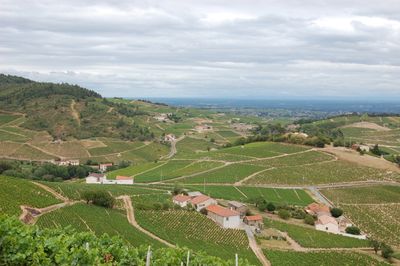
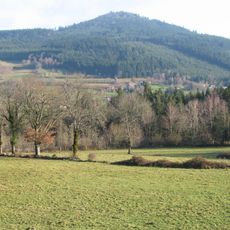
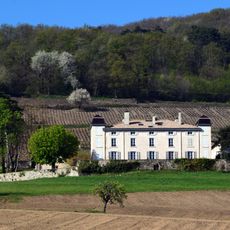
Beaujolais Geopark covers about 1,550 km2 across 121 communes in the north of the Rhône department, from the Saône plain eastward to the Beaujolais mountains, which reach 1,012 m at Mont Saint-Rigaud. Its vineyards climb gentle slopes cut by wooded valleys, and the photograph shows dense parallel rows of vines crossed by tan tracks, with white-walled, red-roofed buildings scattered among the plots. The park was awarded UNESCO Global Geopark status in April 2018.
The area gained UNESCO Geopark status in 2018, recognizing its geological layers that span 500 million years. This designation came after thorough scientific research documenting how complex the region's rock formations really are.
The name comes from the seigneurie de Beaujeu, though Villefranche-sur-Saône is the region's centre. Red wines are made only from Gamay, fermented whole by carbonic maceration, and ten crus such as Morgon, Fleurie and Moulin-à-Vent carry the top status. Since 1951 the primeur release has been sold on the third Thursday of November, a marketing form introduced by winemaker Georges Duboeuf.
The geopark covers 121 communes over roughly 1,550 km², stretching about 50 km north along the Saône from Lyon towards the Mâconnais. Around thirty geosites are listed, among them the Espace Pierres Folles at Saint-Jean-des-Vignes, the Glay quarries at Saint-Germain-Nuelles and the 4.5 km geological trail between Chasselay and Poleymieux-au-Mont-d'Or. The Glay quarries are the only Rhône quarry laid out for visits, with explanatory panels along a marked route.
At the Tour Bourdon site in Régnié-Durette, large sandstone blocks uncovered during vine planting were set up as a megalith scaled to 1/1000 of Mont Blanc. The hilltop also gives a 360° panorama over the Ardières valley.
The community of curious travelers
AroundUs brings together thousands of curated places, local tips, and hidden gems, enriched daily by 93,140 contributors worldwide.