Grotte Sarrazine, Natural cave entrance in Nans-sous-Sainte-Anne, France.
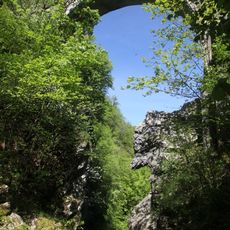
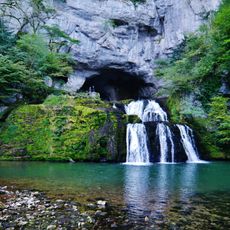
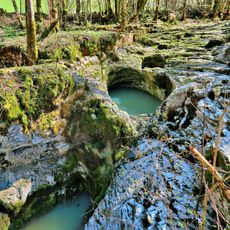
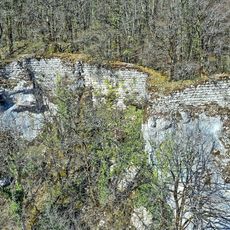
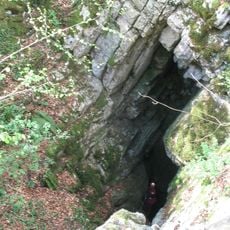
Grotte Sarrazine is a limestone cave entrance beneath a 100-meter-high and 30-meter-wide arcade at the base of a cliff in the Doubs department. The opening marks a point where underground waters emerge to the surface.
Eugène Fournier first investigated the cave in 1910, while more extensive explorations took place in 1950 by the Paris Speleology Club. These systematic investigations led to mapping of previously unknown underground sections.
The painter Gustave Courbet captured this cave entrance in his 1864 artwork 'La Grotte Sarrazine près Nans-sous-Sainte-Anne'. The painting shows how this location has inspired artists across different periods.
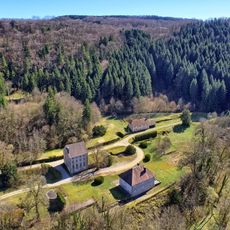
Access to the cave is via a hiking trail starting from the Lison spring parking area, which crosses two footbridges over the Lison and Bief Sarrazin rivers. The terrain is relatively flat and walkable for most visitors.
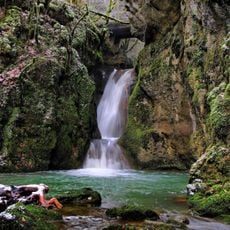
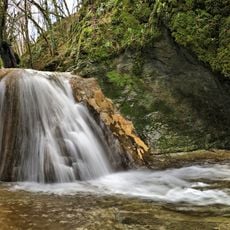
During flood events, the normally dry cave transforms into a powerful resurgence, discharging up to 16 cubic meters of water per second through the Bief Sarrazin stream. This sudden change reveals the hidden power of the underground water system.
The community of curious travelers
AroundUs brings together thousands of curated places, local tips, and hidden gems, enriched daily by 60,000 contributors worldwide.