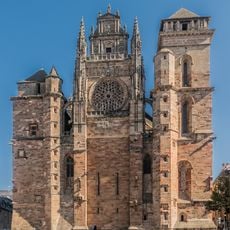
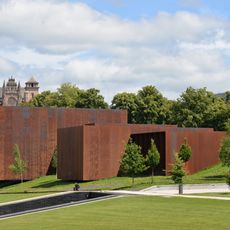
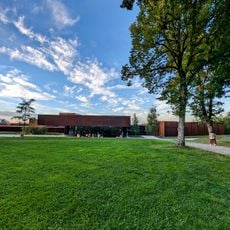
Chartreuse de Rodez, Carthusian monastery in Rodez, France.
The Chartreuse Notre-Dame d'Aveyron is a former Carthusian monastery in Rodez. Its tan-plastered buildings combine a steeply pitched tiled roof over a lower wall pierced by two shuttered windows with a square tower capped by a bulbous roof of grey scalloped tiles and a metal finial. A round clock with a blue centre sits above an arched stone doorway.
Hélion Jouffroy, a canon of Rodez Cathedral, founded the charterhouse in 1511; Louis XII authorised construction in 1512, and the church was consecrated in 1529. The community dispersed in July 1791 after the Revolution suppressed religious vows, and the convent was sold as national property in 1798. From 1809 to 2017 the buildings housed a national stud farm.
The name recalls Notre-Dame d'Aveyron, and the site began as a Carthusian house whose monks first lodged at the borie d'Albespeyres, now La Boriette. In 1514 they built the small chapel of Notre-Dame-de-Pitié on the chemin de la Boriette, with four cells for the religious. Since 1809 the buildings have served as a national stud farm, and a third-place project was presented on 19 December 2019.
The former monastery stands in Rodez, its buildings used as a national stud farm from 1809 until 2017. A project to turn the site into a third place for work, life and exchange was presented on 19 December 2019. The entrance courtyard buildings were rebuilt in the 18th century, and the great enclosure walls were begun in 1734.
The 1514 plan of the monastery site, drawn to show the plots to be bought, marks the cathedral then under construction and the old episcopal palace; copies are kept at the Société des lettres de l'Aveyron and the Aveyron departmental archives. A 17th-century oil painting of the charterhouse, 2 by 1.5 metres, hangs at the Correrie museum of the Grande Chartreuse.
The community of curious travelers
AroundUs brings together thousands of curated places, local tips, and hidden gems, enriched daily by 92,870 contributors worldwide.