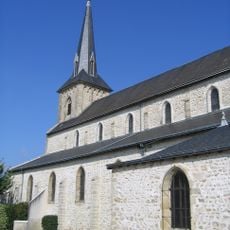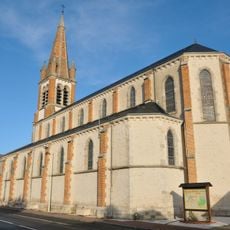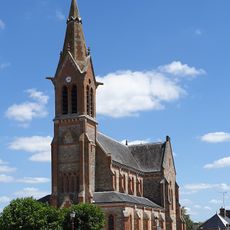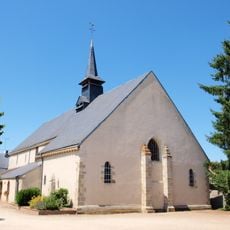
Site archéologique de Vienne-en-Val, Archaeological site in Vienne-en-Val, France.
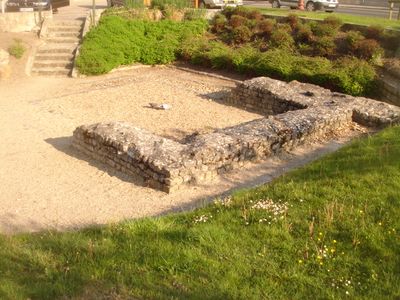
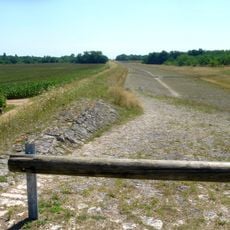
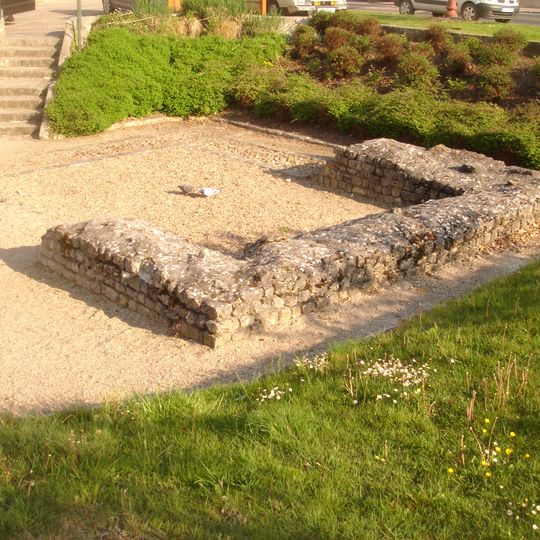
The archaeological site of Vienne-en-Val lies on the place de l'église Saint-Martin, where excavation left low walls of rough grey and tan stone bound with mortar, forming an open rectangular outline on pale gravel; a single stone lump sits inside. No antique settlement remains in place, and the carved blocks found here are kept in a communal lapidary museum room nearby.
The site was discovered in 1968 during sanitation work when builders uncovered carved Roman stone blocks beneath the surface. Archaeologists then preserved these findings and studied how the location had been inhabited from ancient through medieval times.
The most notable carved block is a square base 0.59 m wide and 1.16 m tall, a "four-gods stone": Vulcan on a ship's prow and Venus with Cupid on opposite faces, Jupiter and Mars above a repeated inscription on the others. It belonged to a monument to Jupiter, perhaps a votive column, and the dedications suggest non-citizen peregrini, around the third quarter of the 2nd century CE.
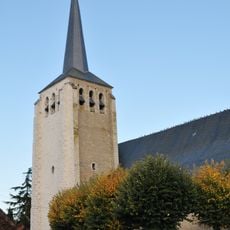
The excavated remains are displayed in the open air on the Place de l'église Saint-Martin, where low stone wall segments outline the successive church plans on gravel. The finds are kept in a communal lapidary museum room near the site, not on the grounds.
The most notable reused block is a square base 0.59 m wide and 1.16 m high, a "four-god stone": Vulcan on a ship's prow and Venus with Cupid on opposite faces, Jupiter and Mars above a repeated inscription on the others. It belonged to a Jupiter monument, perhaps a votive column, a type rare in Gaul and known mainly in Germania.
The community of curious travelers
AroundUs brings together thousands of curated places, local tips, and hidden gems, enriched daily by 94,418 contributors worldwide.