Rocher Corneille, Volcanic plug in Le Puy-en-Velay, France.
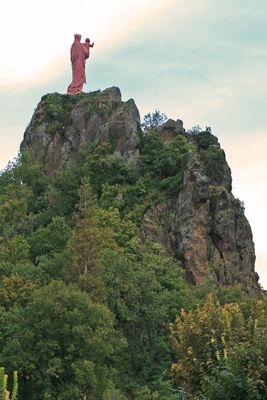
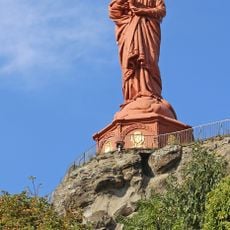
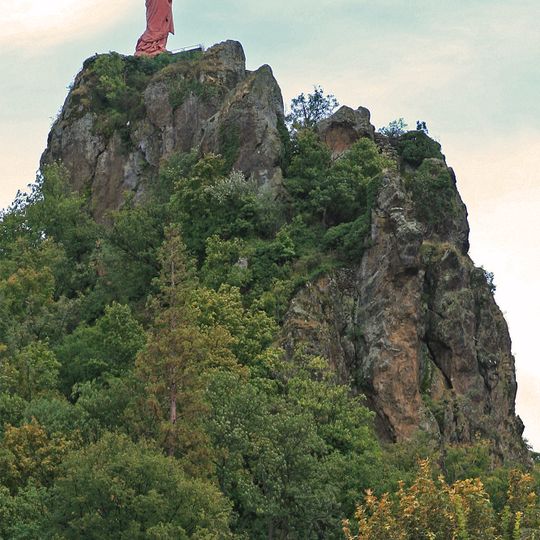
Rocher Corneille is a basalt volcanic plug 132 metres high, reaching 741 metres above sea level in the centre of Le Puy-en-Velay. Its rough grey-brown flanks are split by deep vertical crevices and blocky ledges, with scrub clinging to the base. On the narrow, uneven summit stands the 16-metre cast-iron statue of Notre-Dame de France, on a 6.70-metre pedestal of Blavozy arkose.
The rock was quarried from Roman times until 1840, and those extractions shaped the faces people read in it: Henri IV, Gargantua or a lacemaker depending on the era. Its volcanic origin was only understood after the 1963 Surtsey eruption in Iceland. The Notre-Dame de France statue was cast from cannons taken at the siege of Sevastopol and designed by Jean-Marie Bonnassieux.
The rock's outline has been read as a face of King Henry IV, of Gargantua or of a lacemaker, depending on the era. Quarrying from Roman times until 1840 shaped these profiles. The summit statue, Notre-Dame de France, was planned by Jean-Marie Bonnassieux and cast from cannons captured at Sevastopol.
Visiting requires climbing a narrow spiral staircase inside the statue, which is not suitable for people with limited mobility. It is best to come early in the morning when fewer people are present and the views can be clearer.
The 16-metre statue of Notre-Dame de France was cast in 1856-1860 from 213 cannons taken at the siege of Sevastopol during the Crimean War, to plans by Jean-Marie Bonnassieux. It stands on a 6.70-metre pedestal of Blavozy arkose, and its total mass is estimated at 835 tonnes, of which 110 for the statue itself.
The community of curious travelers
AroundUs brings together thousands of curated places, local tips, and hidden gems, enriched daily by 95,348 contributors worldwide.