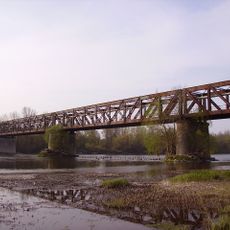
Viaduc de Saint-Satur, Railway viaduct in Saint-Satur, France.
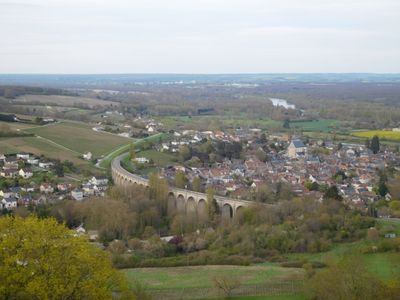
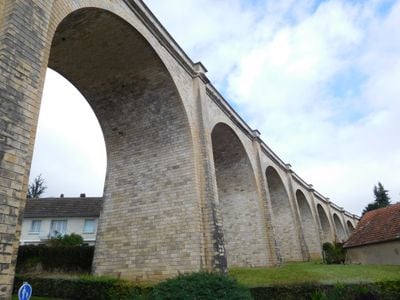
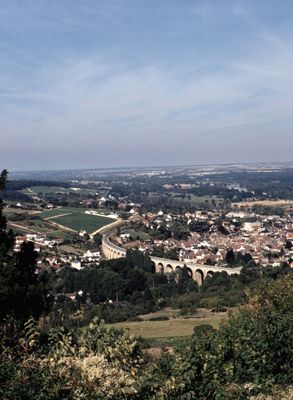
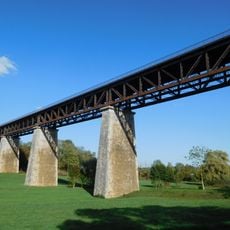
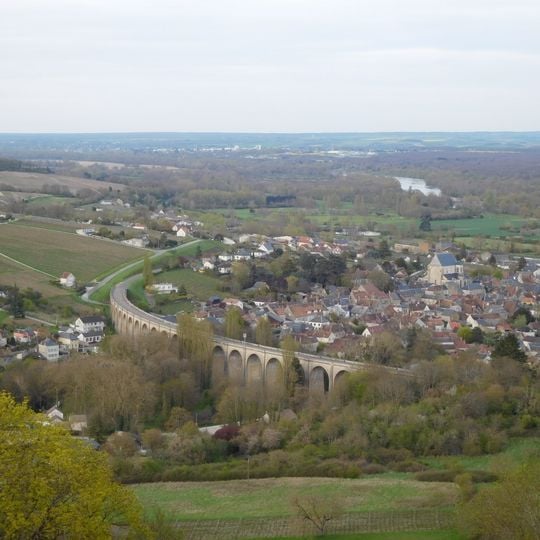
The Viaduc de Saint-Satur is a railway viaduct in Saint-Satur that spans across a valley landscape with multiple stone arches, connecting both sides of the terrain. The structure rises significantly above ground level and provides a continuous passage over the lower-lying areas.
The line from Bourges to Cosne was declared of public utility on 31 July 1888, and construction of the viaduct began in 1891, financed entirely by the state. The piers and arches were built between 14 March and 18 September 1892, using stone from La Manse, Senozan and Souppes-sur-Loing, with up to 50 stonemasons on site. The bridge opened on 25 November 1893. After passenger service ended in June 1966, the municipality bought the viaduct and converted it into a road bridge.
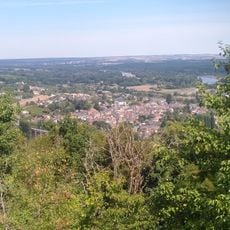
The viaduct spans the valley of the La Colette stream between Saint-Satur and the hamlet of Fontenay. Its name ties it to Saint-Satur, the village it curves around on a 500-metre radius. Since 1966 the structure has carried a communal road rather than rails, so today it serves local road traffic above the stream.
The viaduct now carries a local road, so it is crossed on foot or by car rather than along a dedicated path. It stands west of the village centre, between the former Sancerre and Saint-Satur stations, and spans the La Colette valley between Saint-Satur and the hamlet of Fontenay. The deck is a curved roadway with a low parapet on each side.
The viaduct was built in a 500-metre-radius curve around Saint-Satur, and its piers rest on foundations sunk 4 to 12 metres to reach solid rock. Only piers 22 and 23, between the Sancerre road and the Rue des Braies, stand on piles 2.50 to 11.50 metres long. Building stone reached the site by a metre-gauge narrow-gauge railway from the Canal latéral à la Loire.
The community of curious travelers
AroundUs brings together thousands of curated places, local tips, and hidden gems, enriched daily by 94,466 contributors worldwide.