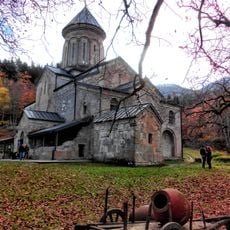
Church of Tsromi, Early medieval church in Tsromi village, Khashuri Municipality, Georgia.
The Church of Tsromi sits at the heart of its village along the Mtkvari River, built with a cross shape and four independent pillars that rise to support the central dome. Natural light streams inside through high windows set into the dome and along each arm of the cross.
The church was built in 626–634 on the order of Stephen II, eristavi of Kartli, over the ruins of an older church where, according to chronicles, Razhden was martyred in 457. It was altered between the 11th and 12th centuries and again in the 16th–17th; its wall was destroyed in a Lekian raid on 24 September 1731. The earthquake of 8 May 1940 brought down the dome and much of the vaulting; restoration began in 1949 under L. Khimshiashvili, and a trial wooden dome was installed in 1974–1975.
The conch of the altar held a 7th-century mosaic of the "Glory of Christ," linked to the Ascension; most was destroyed and the surviving fragments were moved to the Museum of Art of Georgia. Only the contours of the preparatory drawing remain in the apse. The eastern facade's two deep triangular niches, first used here beside the apse, became a recurring feature of Georgian church design.
The church stands in the centre of Tsromi village, on the right bank of the Mtkvari, about 3 km from Gomi railway station. The 1940 earthquake brought down the dome and parts of the walls, so expect a reinforced structure with a trial wooden dome rather than the original covering. Dress for a working place of worship.
This was the first Georgian religious building to use four independent pillars supporting the central dome, representing an architectural innovation of its time. This structural system later became a model that influenced other church constructions across Georgia.
The community of curious travelers
AroundUs brings together thousands of curated places, local tips, and hidden gems, enriched daily by 93,271 contributors worldwide.