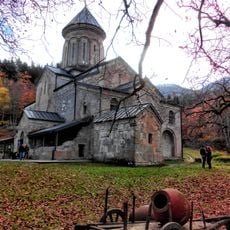
Samtsevrisi church, Medieval Orthodox church in Kareli Municipality, Georgia
Samtsevrisi is a small domed church of the "free-cross" type, built of hewn grayish-reddish sandstone blocks measuring 9.6 by 8.8 meters and rising 10.6 meters. Its cross plan is clearly expressed inside and out, with a horseshoe apse and an octagonal dome resting on four large and eight smaller squinches. The only exterior decoration is around the windows and the entrance, which is on the south side.
The building was constructed in the first half of the seventh century and demonstrates the development of Georgian sacred architecture through its free-cross floor plan. After earthquake damage occurred in the mid-twentieth century, extensive repair work was undertaken to preserve the structure.
Two inscriptions in medieval asomtavruli script survive on the façades. The eastern one records that Domnisos and Georgi Tualaisadze built a water canal in the 20th regnal year of Constantine III of Abkhazia, around 914. The southern inscription names Merab Panaskerteli, who renovated the church in the late 15th or early 16th century and rededicated it to Saint George.
The church stands on a low hill on the left bank of the Dzama, visible from the main east–west highway and railway to the north. Access is by road from Samtsevrisi village; the final approach is on foot over uneven ground. The mausoleum of Merab Panaskerteli lies immediately south of the church, and Samtsevrisi Castle and Monastery are down the slope to the north-west.
The building was originally constructed with exposed sandstone blocks that have weathered the elements over many centuries. Twentieth-century restoration efforts proved necessary to keep the original structure from deteriorating further.
The community of curious travelers
AroundUs brings together thousands of curated places, local tips, and hidden gems, enriched daily by 94,420 contributors worldwide.