Ruisi cathedral, Orthodox cathedral in Kareli Municipality, Georgia
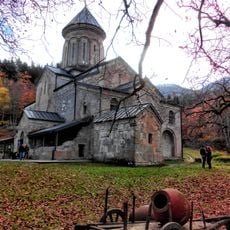
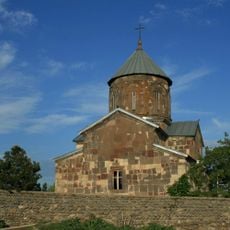
Ruisi cathedral is a cross-in-square church of 27.3 × 19.6 m and 23.3 m high, built of dressed sandstone blocks with basalt, limestone and brick added in later repairs. Its tall dodecagonal dome rests on four free-standing piers, and a deep bema ends in a horseshoe apse. A 15th-century arched narthex stands at the west door; a 17th-century three-storey bell-tower is set in the defensive wall.
The oldest masonry, in the altar area, dates to the 8th or 9th century; the church was remodeled in the 10th and 11th centuries, when the dome and north aisle were rebuilt. After near-total destruction in Timur's invasion of 1400, King Alexander I (r. 1412–1442) levied a special tax to fund its reconstruction, recorded in an inscription on the west façade; the south façade names the architect Shalva. Bishop Dionise Laradze restored it in the 16th century and Queen Mariam of Kartli in the 1660s.
Ruisi was the seat of a bishop bearing the title Mroveli; Bishop Leonti is credited with compiling a corpus of Georgian chronicles here in the 11th century. The church also keeps a memory of King Alexander IV of Imereti, held prisoner at Ruisi and killed here in 1695, buried in the church.
The building is visible from the Gori-Khashuri highway, making it easy to spot when traveling through the area. You can approach from different directions and enter through one of the three doorways depending on where you arrive from.
The cathedral hosted the coronation ceremony of King George II in 1055 and later held a major church council convened by King David IV in 1103. These two key events linked this location to the highest levels of Georgian royal and ecclesiastical authority.
The community of curious travelers
AroundUs brings together thousands of curated places, local tips, and hidden gems, enriched daily by 93,176 contributors worldwide.