Eiffel bridge, Railway bridge in Borjomi, Georgia
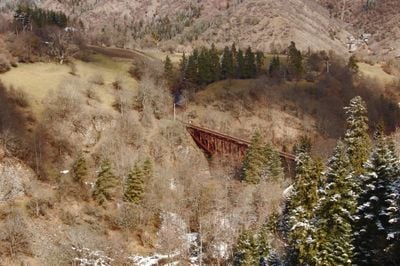
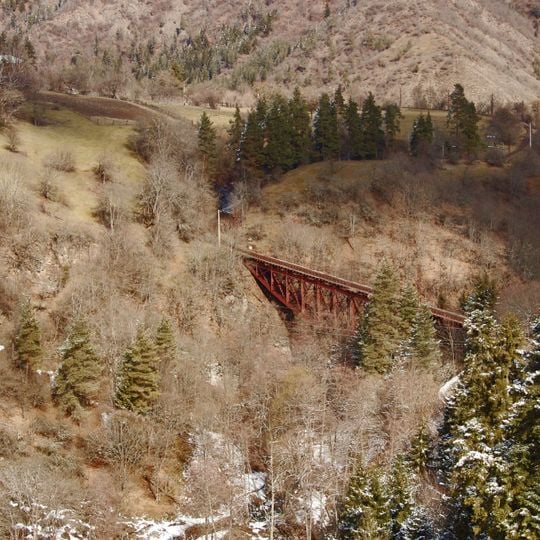
The Eiffel Bridge is a lattice-truss railway bridge over the Tsemistskali River on the narrow-gauge Borjomi–Bakuriani line. Its dark reddish-brown metal structure has two straight horizontal spans joined by a central truss section that angles down into a shallow V, resting on abutments at each end. The bridge stands among bare trees and snow-dusted ground.
The viaduct was commissioned in 1897 by Mikhail Romanov from Gustave Eiffel's company, which had just completed the famous Eiffel Tower in Paris the year before. It became part of a railway project to connect mountain regions in Georgia.
Locals call the narrow-gauge train that crosses the bridge "Kukushka" (little cuckoo), and the name has stuck to the bridge itself. The line runs between Borjomi and Bakuriani; the first train passed over in January 1902. The bridge is listed as cultural heritage site No. 12144.
The bridge carries the narrow-gauge Borjom–Bakuriani line over the Tsemistskali River on the Tsaghveri–Tsemi stretch; trains cross it, but there is no footpath, so visitors cannot walk across. View it from the riverbanks below or from the train window. The metal lattice is dark reddish-brown and stands among bare trees and snow-dusted ground in winter.
The original metalwork from Eiffel's company remains intact today, making it a rare example of 19th-century French industrial architecture in the Caucasus. Few visitors realize that a Georgian engineer named Besarion Keburia oversaw much of the actual construction work on site.
The community of curious travelers
AroundUs brings together thousands of curated places, local tips, and hidden gems, enriched daily by 94,579 contributors worldwide.