Párizsi udvar, Gothic shopping arcade in central Budapest, Hungary
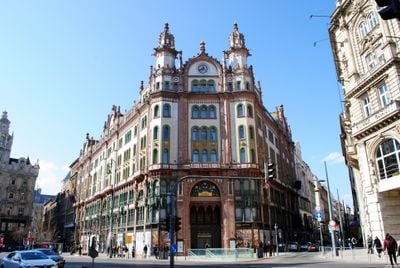
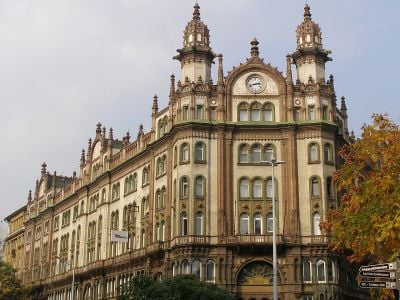
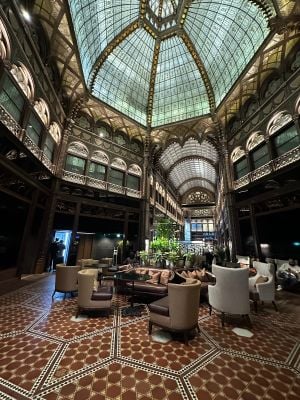
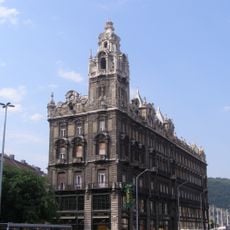
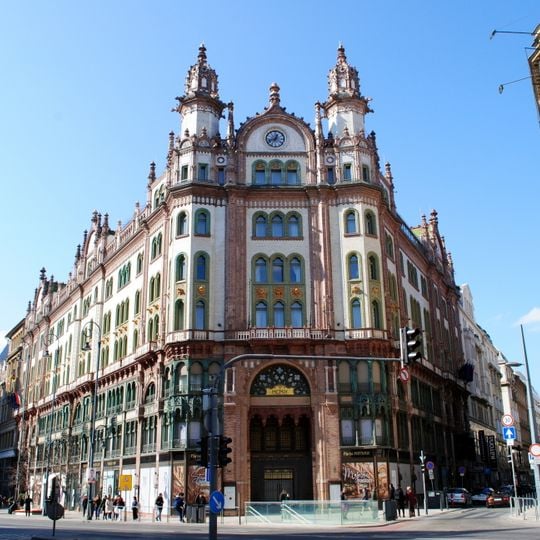
Párizsi udvar is a historicist corner building at Ferenciek tere, its pale stone and brick-brown facade crowned by two octagonal towers with domed roofs and a central clock face. The ground floor holds a covered shopping passage under a hexagonal glass roof of pressed luxfer prisms; the entrance arch reads "PÁRIZSI UDVAR" in gold letters, and "MCMXII" marks the dark arched doorway.
The building was constructed between 1909 and 1913 under architect Henrik Schmahl's direction. It replaced an earlier commercial structure from 1817 that had been modeled after Paris' Passage des Panoramas shopping arcade.
The name Párizsi udvar continues the nickname of the 1817 Brudern-ház, whose shop passage was likened to the Passage des Panoramas in Paris. The ground-floor arcade keeps that function as Budapest's only surviving early-20th-century shopping court. The facade ceramics came largely from German factories, with only the balcony band and the strip beneath it made at the Zsolnay works in Pécs.
The building sits near Ferenciek tere metro station for easy access. Today it operates mainly as a luxury hotel with restaurants and other amenities available to visitors.
The hexagonal space of the arcade is covered by pressed-glass "luxfer" prisms made by the Haas and Somogyi firm; according to Gáspár Fábián, producing and assembling them took a year and a half. The mahogany portal doors came from the same factory as those of Harrods in London. The building later served as a set for the 2011 film Tinker Tailor Soldier Spy.
The community of curious travelers
AroundUs brings together thousands of curated places, local tips, and hidden gems, enriched daily by 92,726 contributors worldwide.