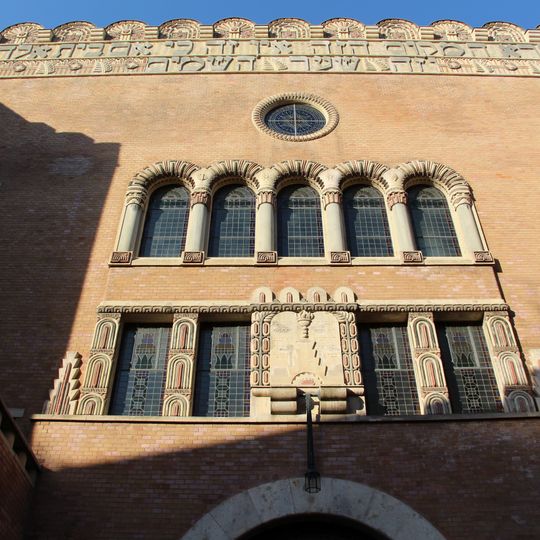
Kazinczy Street Synagogue, Orthodox synagogue in District VII, Budapest, Hungary
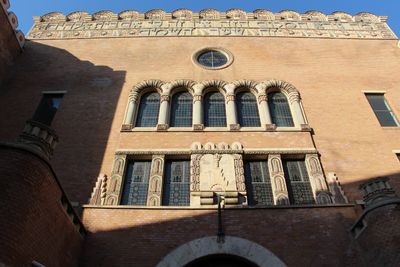
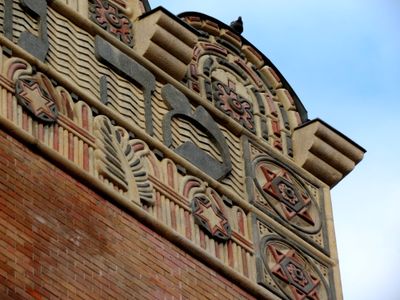
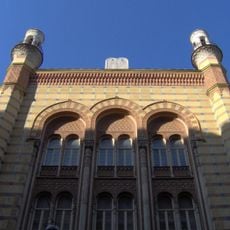
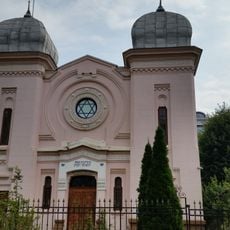
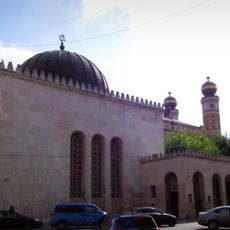
The Kazinczy Street Synagogue is an Orthodox synagogue at 29–31 Kazinczy Street in Budapest's District VII, completed in 1913 to designs by the Löffler brothers. Its tan brick facade rises to a parapet of repeated stone arches above a carved frieze with Hebrew lettering; below are a round window with radiating tracery, three arched windows on stone colonnettes, three rectangular windows, and a carved menorah panel.
After the 1868 split of Pest's Jews into Orthodox, Conservative and Progressive groups, the Orthodox minority built this complex. The Löffler brothers won the 1910 competition; construction began in spring 1912, and the synagogue opened on 29 September 1913, before Rosh Hashanah. Located in the wartime ghetto, it was badly damaged in 1944–45 and restored after 1945.
This place has served as a religious and social center for Budapest's Orthodox Jewish community for generations. Beyond prayer, the building houses educational spaces and community facilities that reflect how members of this faith practice their traditions today.
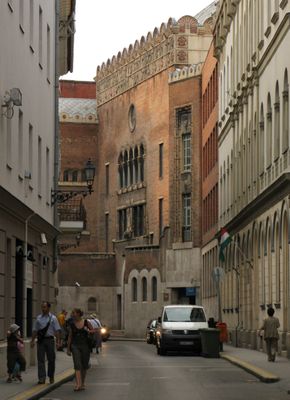
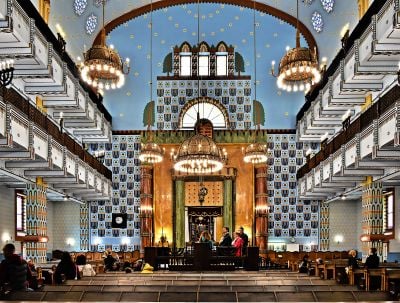
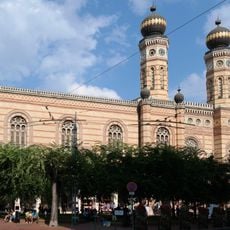
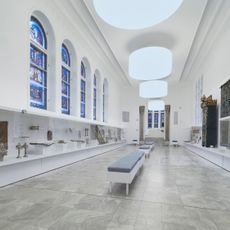
The synagogue stands at Kazinczy utca 29–31, set back from the street line so the facade forms an L-shaped widening; the main gate is reached by four steps, with two smaller side entrances. The great hall is used only on the three pilgrimage festivals and the High Holy Days; summer prayers are held in the Sas-Chevra synagogue and winter prayers in a small prayer room. The building is under renovation, and in 2023 worshippers were locked out.
A distinctive feature inside is an elevated gallery for women that allows them to observe services while maintaining separation as their tradition requires. This spatial arrangement shows how the building was designed around religious customs.
The community of curious travelers
AroundUs brings together thousands of curated places, local tips, and hidden gems, enriched daily by 92,621 contributors worldwide.