Castle of Szigetvár, Medieval fortification in Szigetvár, Hungary
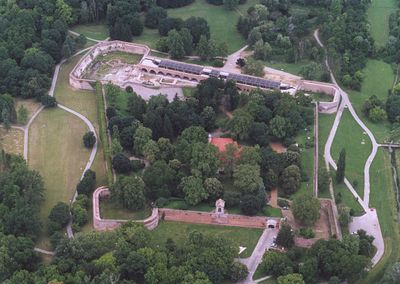
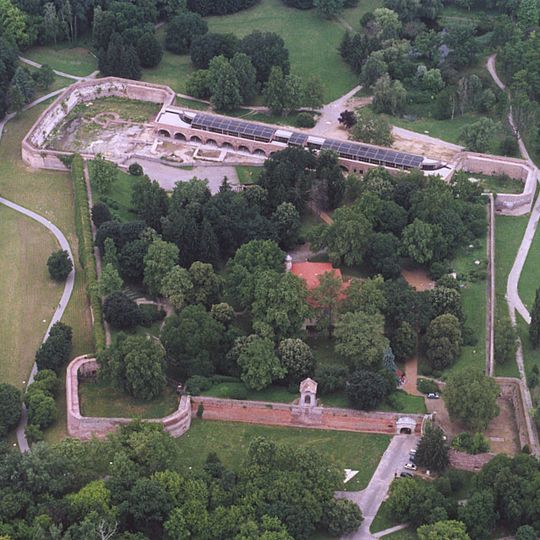
Castle of Szigetvár is a fortification of reddish-brown brick and stone built from 1420 around a round tower on an island of the Almás stream. Its connected walls enclose a bare, uneven courtyard; a long wall topped by a row of dark rectangular panels runs toward the upper right, and a lower wall in the foreground holds a small arched gatehouse with a pitched roof. The Ottomans rebuilt it with walls three metres thick and six metres high, cornered by four Italian-style bastions.
Anthoni Oszvald built the castle around 1420 on an island of the Almás stream; its core was a round tower within a square stone-walled courtyard. After 1526 it blocked the Ottoman advance west, and in 1566 Nikola Zrinski's garrison of about 2,300 men held out for 34 days before the survivors broke out of the burning inner castle. The Ottomans rebuilt it with 3 m thick, 6 m high walls and four Italian-style corner bastions; the Habsburgs took it in 1689.
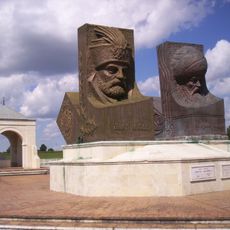
Miklós Zrínyi, commander from 1561, wrote an epic poem about the 1566 siege in 1651, which fixed the castle in Hungarian literature. Inside the fort visitors can see a museum, a mosque with part of a minaret, a sculpture of Zrínyi and Ottoman building fragments. Plans exist to rebuild the truncated minaret with Turkish backing.
The castle museum displays military artifacts, medieval weapons, and architectural pieces from different periods of the fortress. The layout follows the four connected sections, making it straightforward to navigate through the main areas.
Suleiman the Magnificent died in his tent during the siege's final days, but his commanders concealed the news so the weakened army would not lose heart. Zrínyi, aged about 56, led roughly 2,300 defenders for 34 days before the survivors broke out of the burning inner castle. The sultan did not live to see the victory.
The community of curious travelers
AroundUs brings together thousands of curated places, local tips, and hidden gems, enriched daily by 92,623 contributors worldwide.