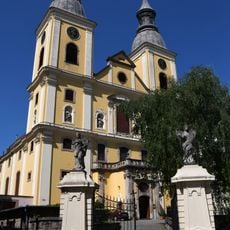
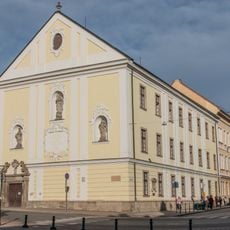
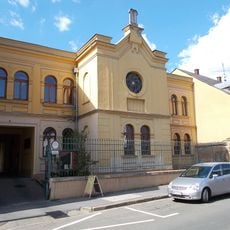
Archiepiscopal Palace, Archbishop's palace in Eger, Hungary.
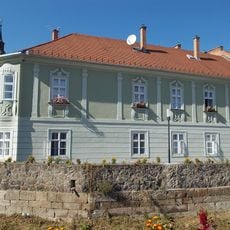
The Archiepiscopal Palace is a U-shaped complex of three wings near Eger Cathedral and the Lyceum. Its eastern main facade faces a courtyard separated from Széchenyi Street by a wrought-iron fence; the central block has three storeys on the east and two on the west. A chapel with oratory adjoins the west side, and the southern wing opens onto Eszterházy Square.
The building was constructed in the early 1700s after bishops returned to the city they had fled during the Ottoman conflicts of the previous centuries. Its construction marked the beginning of the city's revival following the end of Ottoman occupation.
The palace displays Hungarian artworks collected over centuries, reflecting the tastes and interests of successive church leaders. Walking through the rooms reveals how the bishops furnished and decorated their residence to express their status and devotion.
The complex stands at Széchenyi Street 1–5, beside the cathedral and the Líceum. The eastern main façade faces a decorative courtyard separated from the street by a wrought-iron fence; the southern wing opens onto Eszterházy Square. The Archbishop's Visitor Centre is housed in the complex, and the northern wing holds the Archiepiscopal Collection and the archdiocesan archive.
The northern wing, once the estate offices, now holds the Archiepiscopal Collection Centre, where Empress Maria Theresa's coronation mantle is kept. Bishop Gábor Erdődy received it, along with other valuables, as a gift from the empress. The collection is mainly 18th- and 19th-century goldsmiths' and textile work: monstrances, chalices, reliquaries and vestments.
The community of curious travelers
AroundUs brings together thousands of curated places, local tips, and hidden gems, enriched daily by 92,652 contributors worldwide.