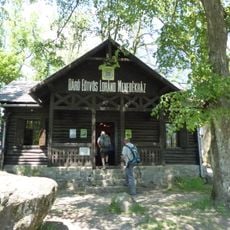
Szoplák Devil's Hole, Cave in Pilisszentkereszt, Hungary
Szoplák Devil's Hole opens on the southeast side of Kis-Szoplák at 486 m above sea level in the Hármas-forrás valley. It is a branching cave 430 m long and 111 m deep, formed in Triassic limestone by warm water and later turned into an inactive sinkhole. Its walls show dissolution forms, and stalactites appear in places.
First recorded visit was in 1883; Ferenc Schafarzik published a study of it in 1884, calling it the most notable cave of the Pilis. In 1953 Károly Ferencz described it as the largest cave in the range. Its current name first appeared in print in 1984.
The name Ördög-lyuk, "Devil's Hole", appears on tourist maps and in print from 1900 (Thirring); earlier records call it Ördöglyuka (Pesty, 1888). The cave has carried many names, including Pilisi Ördöglyuk and Trisztoki ördöglyuk. The current name Szopláki-ördöglyuk was first printed in 1984.
The cave is locked and can only be entered with rope-technical equipment, with permission from the Duna–Ipoly National Park Directorate, outside the bats' winter hibernation period. The vertical entrance lies at the foot of a rock wall beside the green-marked trail from Pilisszentkereszt centre toward Két-bükkfa-nyereg, about 3 km from the village.
The cave's name first appeared in print in 1984, though it has carried many names: Ördög-lyuk, Pilisi Ördöglyuk, Szoplaki-barlang. Schafarzik Ferenc, who descended in 1884, found the ceiling black with bats and the floor covered by a 1–2 foot guano layer.
The community of curious travelers
AroundUs brings together thousands of curated places, local tips, and hidden gems, enriched daily by 93,757 contributors worldwide.