Kinnitty Castle, Gothic revival castle in Kinnitty, Ireland
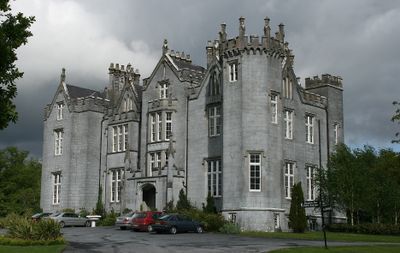
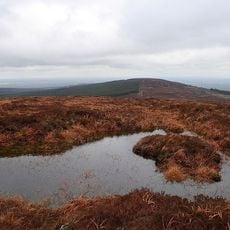
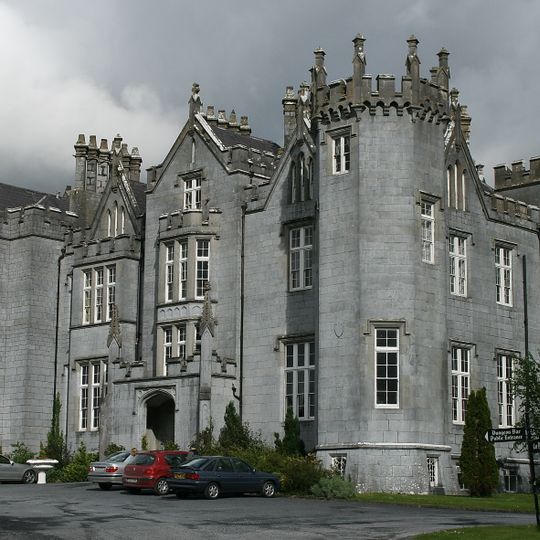
Kinnitty Castle is a Gothic revival castle situated on 650 acres of parkland with 60 acres of rolling lawns near the Slieve Bloom Mountains. It now functions as a four-star hotel containing 37 bedrooms, each with high ceilings and cast iron roll top baths.
The first castle at Kinnitty was destroyed in 1209 and rebuilt by the Normans in 1213, when an Augustinian abbey was also established nearby. In 1630 William O'Carroll built a new castle close to the old abbey; it was confiscated in 1641 and granted to Col. Thomas Winter in 1664. In 1811 Lady Catherine Hutchinson commissioned architect James Pain to extend the house in a Tudor revival style to its present size. Burned by the IRA in 1922, it was restored in 1928 with a government grant of £32,000.
The castle's name changed from Castle Bernard to Kinnitty Castle, and its grounds hold a 10th-century high cross moved there in the 19th century, now weathered. The estate also has an Egyptian-style mausoleum at St Finnian's church, where Captain Richard Bernard, a Crimean War veteran, was buried in 1877.
Kinnitty Castle stands on the R421 between Kinnitty and Cadamstown, north of the Slieve Bloom Mountains. The main entrance is marked by a black sign reading "Dunmore Bar / Public Entrance". About 50 metres left of the main building's entrance is a High Cross, likely from the 10th century and moved here in the 19th century; it is in poor condition.
On the grounds of St Finnian's church stands an Egyptian-style mausoleum holding the remains of Captain Richard Bernard, a former resident of the castle. This unexpected architectural detail reveals the personal history of someone closely tied to the estate.
The community of curious travelers
AroundUs brings together thousands of curated places, local tips, and hidden gems, enriched daily by 92,705 contributors worldwide.