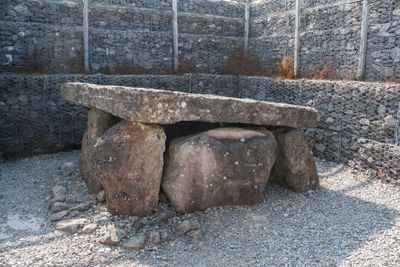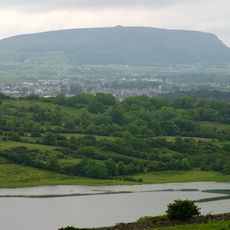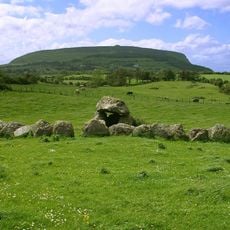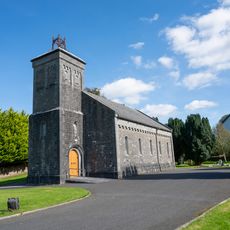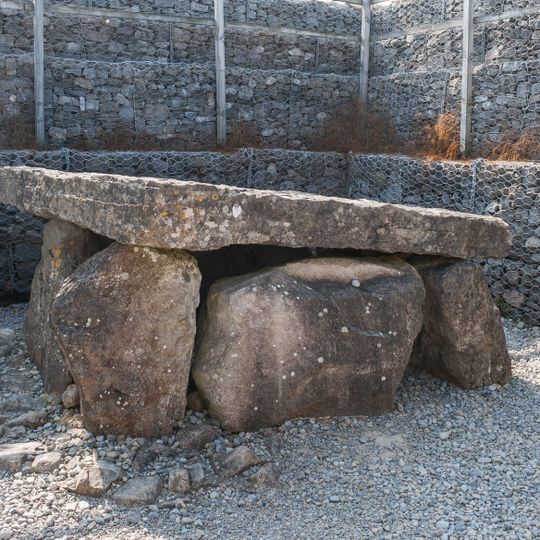
Listoghil, Passage grave in County Sligo, Ireland.
Listoghil is a Neolithic passage tomb in County Sligo with a circular stone structure featuring a central chamber covered by flat stones. The tomb consists of standing stones arranged in a ring-like pattern, forming an enclosed burial space within a wider complex of megalithic monuments scattered across the landscape.
Listoghil was built between 3640 and 3380 BC, and bone and carbon material from the mound was later dated to around 3500 BC. Extensive burning took place on the site before the chamber was erected. In the 1880s workmen quarrying stones for road metal uncovered the burial chamber, which ended the mound's destruction; 19th-century antiquarians recorded horse bones, charred wood and a flint javelin head. Goran Burenhult partly excavated it in the late 1990s and the Office of Public Works restored it.
The Irish name Lios an tSeagail appears on early maps as Lios a' tSeagail, and George Petrie suggested in 1837 it may mean 'Ryefort', from seagail, rye. Lios usually denotes a court or enclosed area, so the name may refer to the ground enclosed by the surrounding dolmens rather than to the cairn itself.
The site is part of the larger Carrowmore complex with informational signs explaining what you are viewing on the ground. It is best to wear sturdy footwear since the terrain can be wet and muddy, especially after rainfall.
The stone arrangement aligns with specific solar positions at certain times of year, revealing that builders possessed knowledge of the sun's movement across the sky. This astronomical attention suggests the tomb served purposes beyond simple burial, possibly connected to seasonal observances.
The community of curious travelers
AroundUs brings together thousands of curated places, local tips, and hidden gems, enriched daily by 94,142 contributors worldwide.