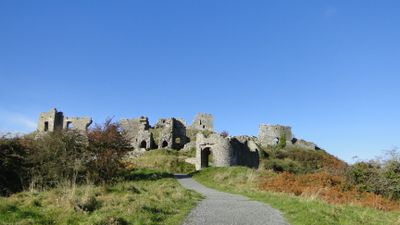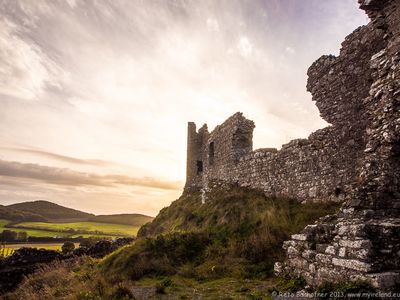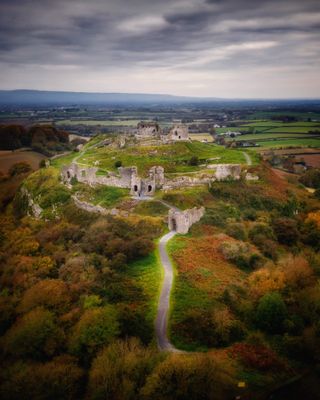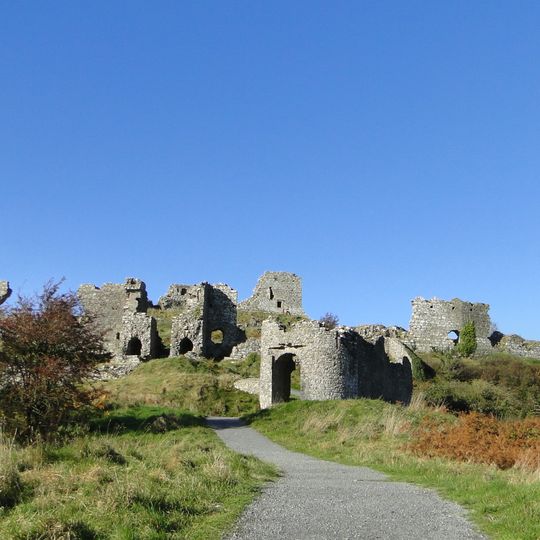
Rock of Dunamase, Medieval fortress ruins on limestone outcrop near Port Laoise, Ireland
Rock of Dunamase is a castle perched on a limestone outcrop near Port Laoise, crowned with stone walls from the 12th and 13th centuries. The ruins rise about 46 meters above the surrounding plain and show distinct layers of construction.
Excavations in the 1990s showed the rock was first settled in the 9th century, when a hill fort or dún was built; Vikings from Dublin attacked it in 845. The castle was built in the second half of the 12th century, and in 1170 Dermot Mac Murrough gave Dunamase and his daughter Aoife to Strongbow. It passed to the Marshal family, was divided in 1247, and was a ruinous shell by 1350. The O'Mores held it from the 1400s, and it was slighted in 1650.
The name Dún Másc means "fort of Másc", and the hill fort gave the site its Irish name. The O'More family, who held the castle from the 1400s, are remembered in County Laois's nickname, "The O'Moore County". A 19th-century poem, Transplanted by William O'Neill, commemorates their move to Kildare in 1574.
The site is reached via the N80 road between Portlaoise and Stradbally, about 6 km east of Portlaoise. There is no entrance fee and access is open year-round, but facilities are limited. The climb to the ruins is over uneven, rocky ground, so wear sturdy shoes and bring water.
An 18th-century restoration effort brought stones from other Irish castles to this site, making the ruins architecturally unusual. You can still spot these materials today mixed in with the original walls, revealing a curious chapter of preservation attempts.
The community of curious travelers
AroundUs brings together thousands of curated places, local tips, and hidden gems, enriched daily by 94,440 contributors worldwide.