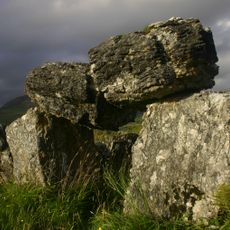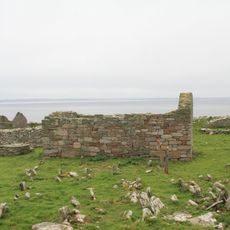
Creevykeel Court Tomb, Neolithic court tomb in Sligo Municipal Borough District, Ireland.
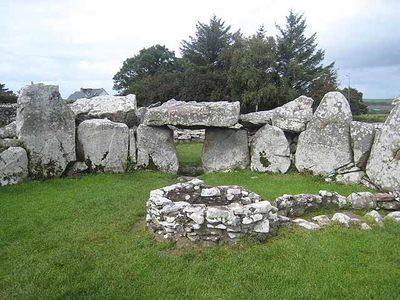
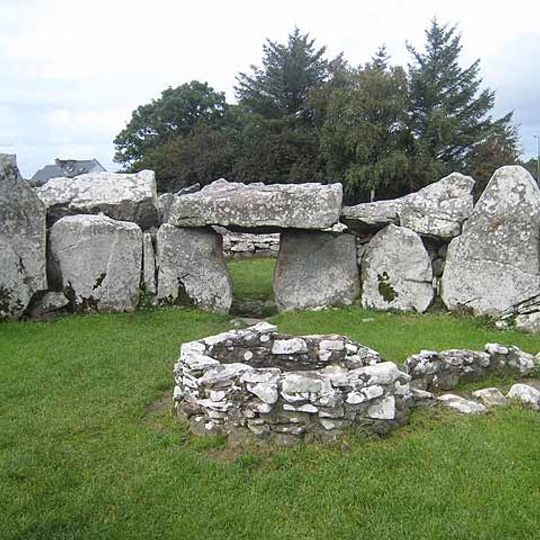
Creevykeel Court Tomb is a Neolithic stone chamber in Sligo made up of connected rooms built from large rocks. The structure has an elongated shape with an open court area in the middle where people could gather.
Built around 3500 BC, the tomb was excavated in 1935 by Harvard's fourth archaeological mission under Hugh Hencken, the first modern scientific dig in Ireland. The cairn was removed and then replaced, revealing a Neolithic cobbled pavement and three hearths in the court. A later Early Christian grain-drying kiln was built at the chamber entrance.
The original name was Caiseal an Bhaoisgin, the Fort of Bhaoisgin, after a well beside the cairn; Creevykeel is the later name. The court was paved with cobbles, and three fires were lit on its western end beneath that paving. Excavators found only tiny chips of cremated bone in three pits in the chamber, which Hugh Hencken read as symbolic deposits rather than full burials.
The monument stands beside the N15 Donegal Town to Sligo road, 50 metres north of Creevykeel cross-roads near Cliffoney. The ground can be muddy and slippery in wet weather, so wear suitable footwear, and visit in daylight. The cairn was fully removed and replaced during the 1935 excavation.
Excavations in 1935 found an Early Christian grain-drying kiln just east of the chamber entrance, with a flue running north to the facade; an orthostat was moved and drilled, perhaps to hold a leather roof over the vent. Iron slag lay inside, showing metalworking on the court's northwest side.
The community of curious travelers
AroundUs brings together thousands of curated places, local tips, and hidden gems, enriched daily by 92,787 contributors worldwide.