Ballinacarriga Castle, Tower house in Dunmanway, Ireland.
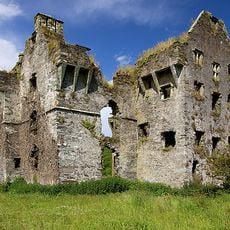
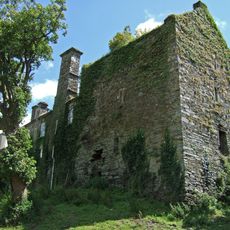
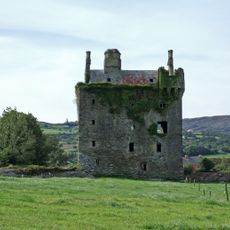
Ballinacarriga Castle is a four-storey tower house measuring about 15 by 12 metres, built on a rock outcrop. It was once protected by a bawn wall with four round corner towers, whose remains are still visible mainly to the north-east. Fine geometric stone carvings survive in the windows and door arches, especially on the top floor, and two small tourelles face each other on the third floor.
The castle was built in the 16th century by the O'Muirthile family as a defensive stronghold during troubled times. Ownership changed several times after the Irish Catholic rebellion of 1641 as the property survived through religious and political upheaval.
The castle's Irish name, Béal na Carraige, means "Mouth of the Rock", after the rocky outcrop it stands on. A room in the tower was once used for Roman Catholic worship and still carries decoration from that use. On the east side, about halfway up, is a Sheela Na Gig, a naked female figure with exaggerated vulva; scholars disagree on whether such carvings warded off evil or represented a fertility figure.
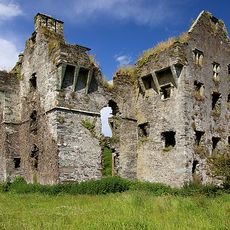
Ballinacarriga Castle stands about 9 km from Dunmanway and 7.5 km from Ballineen, in the townland of Ballinacarriga, with a school nearby. The tower house is a ruin in good structural condition but is not open to the public, so it can only be viewed from outside. Its Sheela Na Gig is on the eastern side, about halfway up the wall.
The structure includes bartizans, jutting corner turrets, and a machicolation system for dropping objects onto attackers below. These defensive features were typical for tower houses of this period and show careful planning against siege attempts.
The community of curious travelers
AroundUs brings together thousands of curated places, local tips, and hidden gems, enriched daily by 93,115 contributors worldwide.