Castle Hackett, Ruined 13th-century tower house near Belclare, County Galway, Ireland
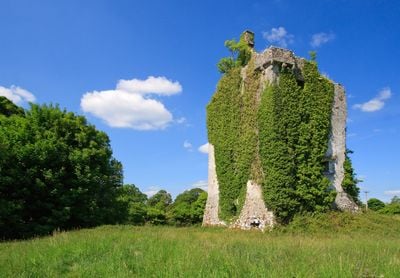
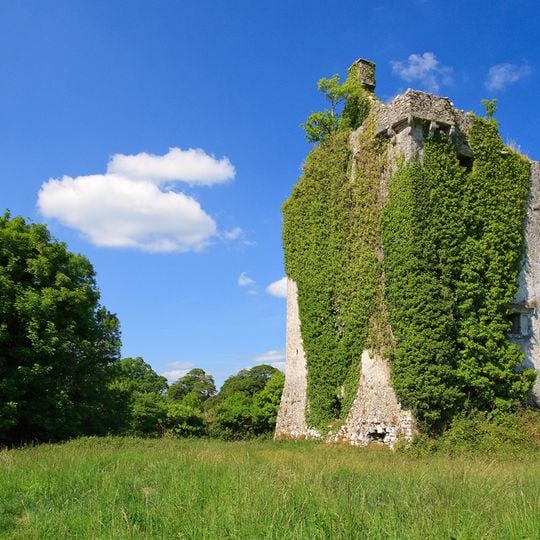
Castle Hackett is a ruined rectangular tower house at the foot of Knockma Hill near Belclare, County Galway. Its jagged, broken top rises from a grassy field; dense ivy covers the upper two-thirds of the front and left walls, while pale grey and brown stonework shows on the lower right. A small stone turret projects near the top left, and a narrow window opening and small dark ground-level doorway sit on the exposed facade.
Castle Hackett was built by the Hackett family, Norman settlers, in the 13th century; Mike Salter suggests it began as a hall house, with two upper storeys added in the 16th century. By the late 16th century it was held by Ullig McReamon Burke. The Kirwans, a Galway tribe, bought the Castlehacket estate in the late 17th century, and the tower house was occupied until at least 1703.
In the introduction to his 1888 Fairy and Folk Tales of the Irish Peasantry, W. B. Yeats names the Hackets of Castle Hacket, Galway, as a family said to have had a fairy for their ancestor and to be favoured or plagued with fairy-seeing abilities. The castle stands in the townland of Castlehacket, Irish Caisleán an Haicéadaigh.
Castle Hackett stands in the townland of Castlehacket near Belclare, about 10 km south-west of Tuam at the foot of Knockma Hill. The tower house is a ruin in a grassy field with no internal access, so it is seen from outside. The surrounding land is farmland; keep to field edges and gates.
The Kirwan family later abandoned the original tower house to build a three-story manor on the property. That manor house was destroyed by fire in 1923 during the Irish Civil War.
The community of curious travelers
AroundUs brings together thousands of curated places, local tips, and hidden gems, enriched daily by 92,633 contributors worldwide.