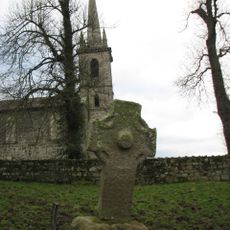
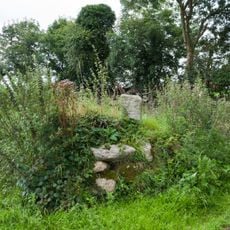
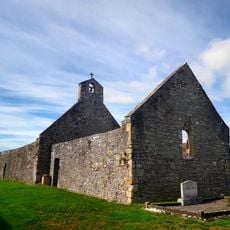
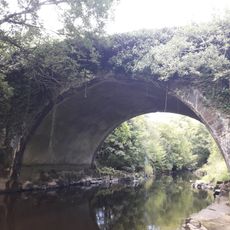
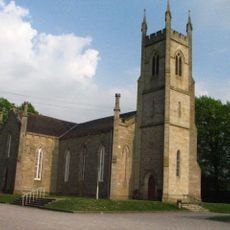
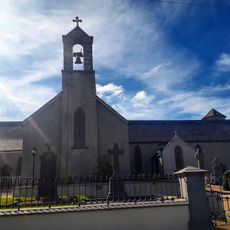
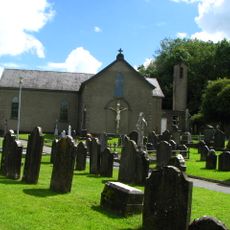
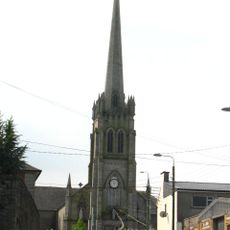
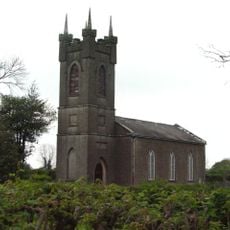
St Laserian's Cathedral, Anglican cathedral in Old Leighlin, Ireland.
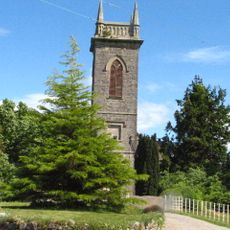
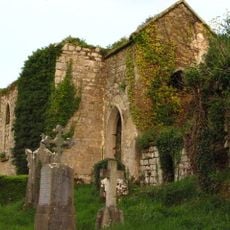
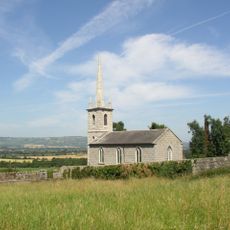
St Laserian's Cathedral is one of Ireland's smallest cathedrals, with an 82-foot nave, a 59-foot choir rebuilt in the mid-16th century and a 59-foot central tower. Hardly any two parts are symmetrical, down to the window styles; the nave's only window sits above the western door. The north transept stands roofless and the south transept was demolished.
A monastery founded by St Gobhan in the early 7th century stood here; in 630 St Laisrén persuaded Irish bishops at a synod held on the site to adopt the Roman calculation of Easter. The wooden monastic buildings burned around 1060, and Leighlin was named one of five Leinster bishoprics at the Synod of Ráth Breasail in 1111. Construction of the present cathedral began under Bishop Donatus (c.1152–1181) and the nave and choir were finished by the end of the 13th century.
The name Leighlin derives from the monastery founded by St Gobhan, whose brother St Laisrén gave the cathedral its dedication. In 630 Laisrén persuaded Irish bishops gathered here to adopt the Roman calculation of Easter. The 11th-century font, probably the oldest item in the church, is still pointed out to visitors.
The cathedral stands in Old Leighlin village, about 12 km south of Carlow town. The north transept is roofless and the south transept was demolished, so the building's footprint is irregular; look for the 17th-century buttress blocking a 13th-century chancel window. The 11th-century font, one of two in the church, is probably the oldest item inside.
An underground passage of mysterious origins runs beneath the cathedral, remaining one of its greatest puzzles. This hidden structure sparks curiosity about its original purpose and why it was built into the medieval design.
The community of curious travelers
AroundUs brings together thousands of curated places, local tips, and hidden gems, enriched daily by 93,121 contributors worldwide.