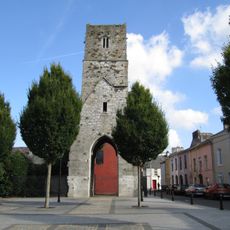
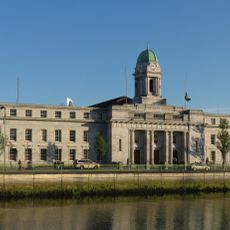
Holy Trinity Church, Cork, Gothic Revival church in Cork, Ireland.
Holy Trinity Church is a limestone Regency Gothic Revival church on Fr. Mathew Quay, on the bank of the River Lee in Cork. Its façade, completed in 1890 to Dominic J. Coakley's design, has a Gothic-Revival portico but no spire. The sculptor John Hogan carved two heads flanking the main door, and the interior holds three stained glass windows by Harry Clarke's studio.
The Capuchins planned a new church to replace their cramped South Friary; George Richard Pain won the 1825 competition. The foundation stone was laid on 10 October 1832, Father Mathew's birthday, but work stalled in 1841. The church opened on 10 October 1850 without its portico, and the façade was completed in 1890 for Mathew's centenary.
Holy Trinity is the only church dedicated to Fr. Theobald Mathew, the Capuchin temperance campaigner who arrived in Cork in 1814. Its stained glass includes three windows by Harry Clarke's studio, and a large memorial honours Daniel O'Connell. The sculptor John Hogan carved two heads flanking the main door.
Holy Trinity Church stands on Fr. Mathew Quay on the south bank of the River Lee, a short walk from the Grand Parade across the South Channel. The main door is flanked by two carved heads by sculptor John Hogan, and the interior holds three windows by Harry Clarke's studio and a large memorial to Daniel O'Connell. The building is an active Capuchin friary church, so visitors should time their look around the nave to fit around Masses and other services.
The site on Charlotte Quay, now Fr. Mathew Quay, was marshy ground on Morrison's Island that had to be drained and given a foundation able to bear the church's weight; preparing it cost almost £1,600 before any stone was laid.
The community of curious travelers
AroundUs brings together thousands of curated places, local tips, and hidden gems, enriched daily by 92,761 contributors worldwide.