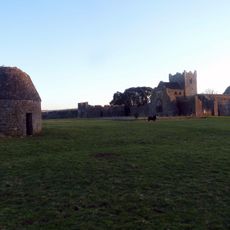
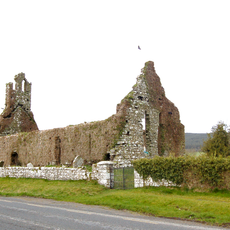
Grangefertagh, Monastery ruins in County Kilkenny, Ireland.
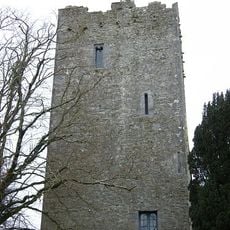
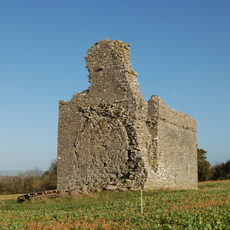
Grangefertagh is a former abbey in County Kilkenny, about 3.3 km north of Johnstown near a crossing-point on the River Goul. Its round tower stands 31 m tall, complete to the cornice with part of the cap remaining, and has nine windows: six angle-headed and three lintelled. West of the tower are the remains of a 13th-century Augustinian church, now partly incorporated into a Gaelic handball alley.
Grangefertagh was founded in the sixth century by Saint Ciarán of Saigir and was known as Fearta-Cáerach, meaning "Sheep's Tomb". In 861 Cerball mac Dúnlainge killed a host of Vikings at Fertagh and took forty heads. A round tower was later built, and in 1156 the high king Muirchertach Mac Lochlainn burned it with the lector inside. The monastery was reopened for the Canons Regular of St Augustine in the early 13th century, rebuilt in 1455 by Thady Megirid, and dissolved in 1541.
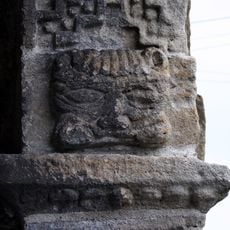
West of the tower stands the 13th-century Augustinian church; its side chapel holds a 16th-century tomb that Carrigan identified as that of Seán Mac Giolla Phádraig, King of Osraige, and his wife Nóirín Ní Mórdha. The chest bears effigies of a man in armour and a woman, carved with tracery and lierne vaulting in relief. A 2020 article notes that scholars, Carrigan among them, regard the tomb as unusual among works by Ormond sculptors.
The site is accessible to visitors who can walk around the ruins and examine the medieval stonework up close. Visit during daylight hours to best appreciate the architectural details of the tower and surrounding structures.
Before 1800, a local farmer took stones from the original doorcase of the round tower because he believed they had magical fire-resistant properties. The doorway visible today is a later repair job, not the original masonry.
The community of curious travelers
AroundUs brings together thousands of curated places, local tips, and hidden gems, enriched daily by 94,365 contributors worldwide.