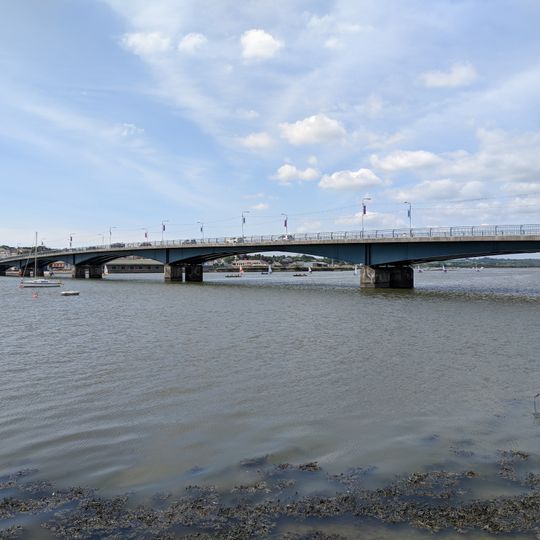
Wexford Bridge, Road bridge in County Wexford, Ireland.
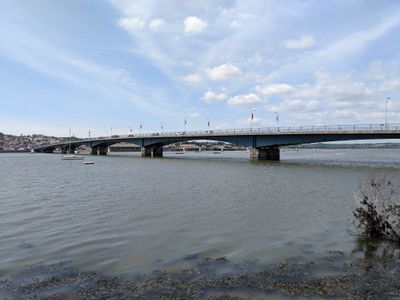
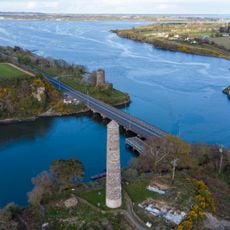
Wexford Bridge is a modern road bridge that connects Wexford town with Ferrybank across the River Slaney. The structure features steel and concrete construction with pedestrian paths on both sides for crossing on foot.
A first wooden bridge by American Lemuel Cox opened in 1795; it collapsed partly in 1827 and was demolished in 1866. A replacement built about a kilometre upstream at Carcur was demolished in 1959. The current bridge, built by a Dutch firm on the original site, opened on 10 September 1959; in 1997 its superstructure was replaced and the piers and abutments reconstructed.
The first wooden bridge, finished in 1795, was the scene of a massacre of nearly 100 local Loyalists by United Irishmen pikemen in 1798; victims were speared and thrown into the Slaney. After the rebellion was crushed, ringleaders including Bagenal Harvey and John Henry Colclough were hanged on the bridge between 25 and 28 June 1798, beheaded, and their bodies thrown into the river.
The crossing accommodates both vehicle and pedestrian traffic with a roadway roughly 12 meters wide. Walking or cycling paths on both sides make it straightforward to cross on foot or by bicycle.
The 1997 rebuild was carried out by Ascon Ltd, which broke up the whole superstructure over ten weeks, reconstructed the piers and abutments, and laid composite concrete slabs made as prefabricated units in Italy. The steel girders sit on seven spans, the longest 63 metres, and the deck is 12 metres wide.
The community of curious travelers
AroundUs brings together thousands of curated places, local tips, and hidden gems, enriched daily by 92,635 contributors worldwide.