Shrine of Bahá'u'lláh, shrine in Bahjí, near Acre, Israel
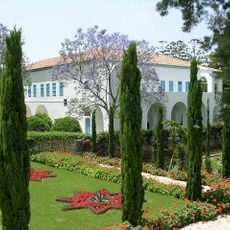
The Shrine of Bahá'u'lláh occupies a stone house beside the Mansion of Bahjí at Bahjí, north of Acre. Its interior is arranged around a central garden roofed with glass by Ghulám-ʻAlíy-i-Najjár, crossed by carpeted paths, with prayer and meditation chambers opening off it. The burial chamber lies in the north-western corner and is not entered; the Inner Court before it has a gilded chandelier, a marble floor and oak doors with gold-leafed rosettes.
Baháʼu'lláh died at the Mansion of Bahjí on 29 May 1892 and was buried the same evening in an adjacent house belonging to his son-in-law, which became the shrine. After ʻAbdu'l-Bahá's death in 1921, Mírzá Muhammad ʻAlí seized the keys in January 1922; the British Mandate authorities returned them to Shoghi Effendi in February 1923. Shoghi Effendi acquired the surrounding land and laid out the gardens, and the Universal House of Justice continued the work after 1957. The site joined the UNESCO World Heritage List in July 2008.
Bahá'ís call the shrine the Rawḍa-yi-Mubáraka, the Blessed Shrine, and face it as the Qiblih during daily obligatory prayer. ʻAbdu'l-Bahá made visiting it a pilgrimage obligation for those able to travel, and formal pilgrimage is still arranged by registration for Bahá'ís only. The Inner Court, the portico before the burial chamber, holds a gilded chandelier, a marble floor and oak doors with gold-leafed rosettes.
The shrine is administered by the Baháʼí World Centre and open free of charge to visitors of all faiths; formal Baháʼí pilgrimage is separate and open by registration to Baháʼís only. The gardens closed to the general public in April 2023 over a tax reclassification dispute and reopened on 19 October 2025. The burial chamber itself is not entered: carpeted paths lead to a room from which it can be seen.
Shoghi Effendi planned a mausoleum of 95 marble columns, each 6 m high, to enclose the stone house, but the design was still unbuilt when he died in 1957. The shrine's glass roof over the central garden was made by Ghulám-ʻAlíy-i-Najjár after Baháʼu'lláh's death in 1892.
The community of curious travelers
AroundUs brings together thousands of curated places, local tips, and hidden gems, enriched daily by 94,069 contributors worldwide.