Misliya Cave, Archaeological cave in Mount Carmel, Israel
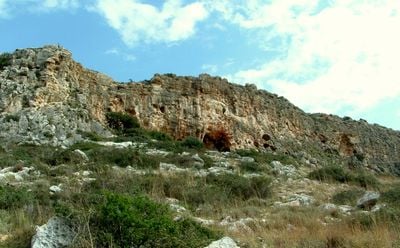
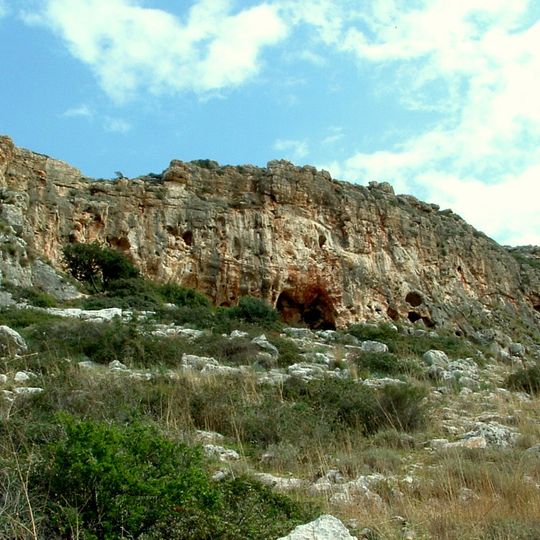
Misliya Cave is a collapsed cave on the western slope of Mount Carmel, now a rock shelter with three natural terraces. Only the eastern half of the upper terrace remains roofed; the rest of the ceiling fell in stages, leaving three shallow niches in a 17–20 m limestone cliff. A 2–4 m thick breccia layer covers the terraces.
Fritz Brotzen first mentioned the cave scientifically in 1927, when it was known as Brotzen Cave. Excavations led by Mina Weinstein-Evron and Israel Hershkovitz began with a pilot dig in late 2000/early 2001 and continued from 2001 to 2010. In 2018, dating of the Misliya-1 maxilla in Science placed it at 177,000–194,000 years old.
The name Misliya is a recent Arabic name; the site was first described in 1927 as Brotzen Cave, after Fritz Brotzen. Excavations since 2001 have exposed three natural terraces under a collapsed ceiling, where burnt flint and ashy hearths about one metre across show daily use of fire.
The site lies on the western Carmel escarpment about 90–95 m above sea level, roughly 500 m south of where Nahal Sefunim reaches the coastal plain, 12 km south of Haifa. It is an active excavation area, so access is not guaranteed; arrange permission with the excavators, based at the University of Haifa's Zinman Institute of Archaeology, before setting out.
The Misliya-1 fossil is the left half of an adult upper jaw with eight teeth still in place, from a wisdom tooth to a canine plus an incisor root. Three dating methods in separate labs placed it at 177,000–194,000 years old, pushing the first migration of modern humans into Eurasia back by more than 60,000 years. The jaw survived because a collapse of the cave roof buried and sealed it about 160,000 years ago.
The community of curious travelers
AroundUs brings together thousands of curated places, local tips, and hidden gems, enriched daily by 94,306 contributors worldwide.