Basilica of Our Lady of Good Health, Catholic basilica in Velankanni, Tamil Nadu, India
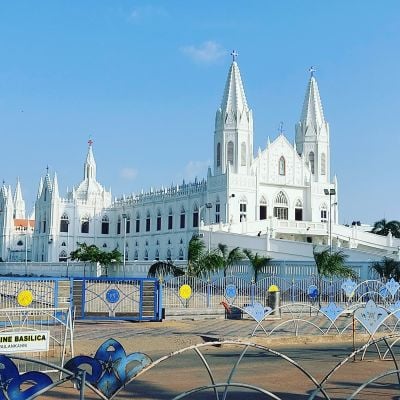
The Basilica of Our Lady of Good Health is a white Gothic-style church in Velankanni, Tamil Nadu, with a red-tiled roof. Its main facade carries two tall symmetrical spires topped with dark crosses, a smaller central gable between them, pointed-arch windows and a recessed entrance; a smaller single-spired tower stands to the left. The southern side was extended in 1928 and the northern in 1933, giving the building the shape of a Latin cross.
Devotion began in the mid-16th century with three reported events: the apparition to a shepherd boy at Maatha Kulam, the healing of a lame buttermilk seller, and the rescue of 150 Portuguese sailors from a storm in the Bay of Bengal. A thatched chapel became a parish church in 1771 under Father Antonio de Rosario. Pope John XXIII raised it to minor basilica on 3 November 1962.
The Virgin Mary is depicted wearing a sari, and the basilica keeps a flagstaff called a Kotimaram or Dwajasthamba, a Hindu element adopted into Catholic worship. During the 29 August to 8 September festival, pilgrims shave their heads and hold ear-piercing ceremonies as offerings, and only women pull the first car of the procession.
The shrine lies in Velankanni, in Kilvelur taluk of Nagapattinam district. Indian Railways runs special trains to Velankanni during the 29 August to 8 September festival, when crowds peak. The main festival church faces west, its facade modelled on the Lourdes basilica in France. Walking pilgrims arrive on foot along the coastal roads.
The flagstaff at the shrine, called a Kotimaram or Dwajasthamba, is a Tamil Hindu temple element adopted into Catholic worship; the Portuguese sailors are said to have planted their ship's mast here as the flagpole, and the festival flag still flies from it.
The community of curious travelers
AroundUs brings together thousands of curated places, local tips, and hidden gems, enriched daily by 92,752 contributors worldwide.