Bagh Caves, Buddhist cave complex in Dhar district, India.
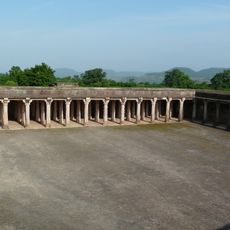
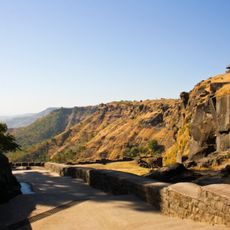
The Bagh Caves are a group of rock-cut Buddhist viharas carved into a perpendicular sandstone face above the seasonal Baghani stream, 97 km from Dhar town in Madhya Pradesh. Nine were excavated; five survive, each with a quadrangular plan and a small rear chaitya chamber. The facade shows rectangular openings between squared rock pillars, with trees partly screening them. Cave 4, the Rang Mahal, holds the finest surviving murals.
The caves were quarried in the 5th-6th century AD, in the late stages of Buddhism in India, long after most Indian Buddhist caves were built. A copperplate inscription of Maharaja Subandhu records a donation for repairing the vihara at Cave 2; his Badwani inscription is dated to the Gupta year 167 (487), placing the repair in the late 5th century. A second inscription, a stone slab found at Cave 2 in 1991, sets out the four realities in a Middle Indic language.
The name Rang Mahal, "Palace of Colors", refers to Cave 4, whose portico walls carried some of the finest murals. Painted in tempera over a reddish-brown mud plaster primed with lime, they depict material rather than spiritual subjects, in a manner close to Ajanta. Fragments remain in Caves 3 and 4, with traces in Caves 2, 5 and 7.
The caves are cut into a sandstone cliff on the far bank of the seasonal Baghani stream, 97 km from Dhar town. The rock face is reached on foot, and the five surviving viharas are entered through their rectangular openings; Cave 2 is the best preserved. The stream is seasonal, so plan around water levels rather than a fixed season.
Of the original nine caves, only five remain fully accessible today. Many of the wall paintings have been moved to the Gujari Mahal Archaeological Museum in Gwalior for safekeeping and further study.
The community of curious travelers
AroundUs brings together thousands of curated places, local tips, and hidden gems, enriched daily by 92,742 contributors worldwide.