Churdhar Sanctuary, Wildlife sanctuary in Sirmaur and Shimla districts, India.
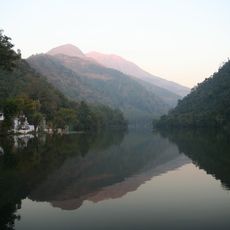
Churdhar Sanctuary is a wildlife refuge located across two districts in Himachal Pradesh, featuring oak forests and high-altitude meadows on sloping mountain terrain. The landscape varies across its span, creating different zones for animals to live and roam.
Churdhar Sanctuary was notified on 15 November 1985, covering 56.16 square kilometres of Sirmaur district in Himachal Pradesh. It is named after Churdhar Peak, at 3,647 metres the highest point in Sirmaur and in the outer Himalayas. Around 1834 George Everest, Surveyor General of India, took astronomical readings from the peak, called "The Chur" in John Keay's The Great Arc.
Churdhar Peak is a holy place tied to Shri Shirgul Maharaj, also called Chureshwar Maharaj, a deity widely worshipped in Sirmour and Chaupal. Pilgrims from Sirmour, Shimla, Chaupal, Solan and Dehradun come to the summit, where the white-painted seated figure with a blue-grey face, a cobra hood behind its left shoulder and a green snake around its neck is draped with orange and red cloth strips.
Multiple trekking paths lead into the sanctuary starting from different base villages in the surrounding valleys, each offering different difficulty levels. The routes climb through varying elevations, so sturdy footwear and careful planning help make the journey smoother.
Churdhar Peak, at 3,647 m the highest in Sirmaur district and the outer Himalayas, appears as "The Chur" in John Keay's The Great Arc. Around 1834 George Everest, Surveyor General of India, took astronomical readings from the summit and measured the earth's curvature there. The sanctuary, notified on 15 November 1985, is administered by the Chureshwar Sewa Samiti.
The community of curious travelers
AroundUs brings together thousands of curated places, local tips, and hidden gems, enriched daily by 92,736 contributors worldwide.